|
Images Index> Matlock Bath, 20th and 21st Century Images> This page |


| Brunswood Road, Matlock Bath - the First Vicarage |
| Matlock Bath : Twentieth Century Photographs, Postcards, Engravings & Etchings |
|
|||||||||
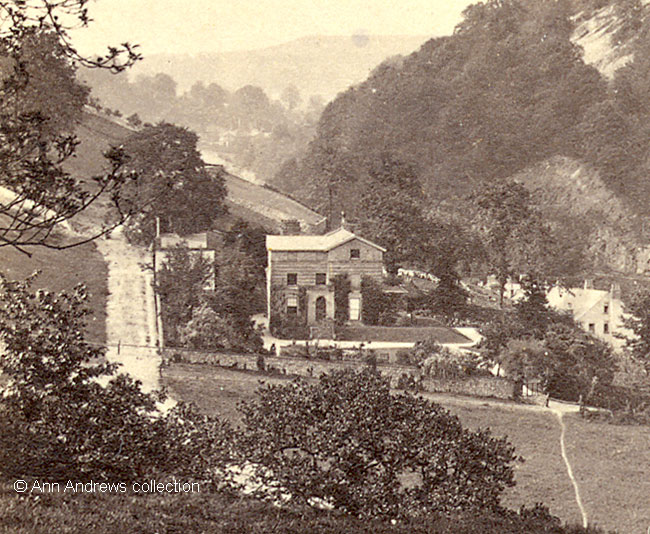
The "Parsonage House" is shown on the 1848 Tithe map, between Key Pasture Wood and Upper Holme next to the main road into Matlock[2]. It was the only property, apart from Fountain Villa, shown in this part of the village and it was years before Holme Road or Brunswood Road were built. Later maps, such as the Ordnance Survey Country Series for 1899 (1:2500) show the long drive from Dale Road, where there was a heavy gate, up to the vicarage as well as a second entrance at the Brunswood Road/Holme Road junction. A fountain was shown in the middle of the lawn. It was there in 1880 but had been removed by 1922. There are a number of blocked up windows around the property. One can be seen on the first floor to the right of the main door and there are others on the side of the building. The web mistress always understood that they were blocked up to reduce the number of windows in the house - so there would be less "Window Tax" to pay. The Window Tax Act was not repealed until 1851, so this is quite feasible. Blank windows could have been installed, as there were with many other buildings, in readiness for reglazing. In the case of the vicarage the space would have needed a whole window to be fitted.
Things were put to rights before Charles Baker and his family moved into the Parsonage[11]. He was the longest serving vicar and remained in the post for thirty years, preaching his last service in May 1914[12]. In his time at Matlock Bath he protested against the erection of a bandstand on Lovers' Walks and his name was inscribed on one of the bell's at Holy Trinity. It was said that he had served the parish as a faithful minister should, earning both respect and love from his parishioners. He also co-operated with the local Nonconformists. He and his successor, Rev. Askwith, exchanged livings and the Barkers moved to Pollington-cum-Barme, near Doncaster[13]. Rev. William Asquith's time at the vicarage spanned the Great War. He was present at the Great Scout Parade, Royal Hotel, 18th March 1917 and his last public act in the village was at the Unveiling of Matlock Bath's War Memorial. His wife had died not long before his departure, whilst on holiday with the family in 1920[14]. There was another exchange of livings, with Rev. Askwith moving to Walton-cum-Dale in Lancashire and Edward John Middlecote Davies arriving from there[15]. Davies held quite strong views on certain matters, not believing in whist drives or dances being held in the Parochial Hall ("to which people from outside the parish might flock") to meet the expenses of the church. He made these views known at the end of a concert in the Hall after allowing some dancing at the event, but with restrictions, stressing that the building belonged to the Church and was not a public building. He did, nevertheless, want people to derive benefit and pleasure from the Hall[16]. He was subsequently appointed vicar of Beeley by the Duke of Devonshire. The curate of High Barnet, Rev. Clement Thomas Walker, took over the reins[17]. He was the eighth vicar at Holy Trinity since the church had been built. He, too, caused controversy with regard to dancing and whist drives by banning both at Scarthin Mission Church though allowing dancing on the stage at a Sunday School concert in 1930[18]. He departed for a Cornish parish at the end of October 1933 so a Buxton Vicar had to step in whilst another vicar was found. The last vicar to live in the property was Reverend Alfred Phibbs who accepted the living in 1934, moving from Bamford-cum-Burstall[19]. It was Rev. Phibbs who conducted the church service that was part of the Procession of Witness in 1935[20]. Some years later he addressed the Parochial Church Council on the subject of how few boys there were in the parish, which meant a shortage of boys who could sing in the church choir. There were more girls than boys in the local day schools[21]. The vicarage subsequently moved to another, slightly smaller, property called Lyndhurst on Brunswood Road but eventually a modern vicarage was built close the church, within the grounds of what had been the Royal Hotel. 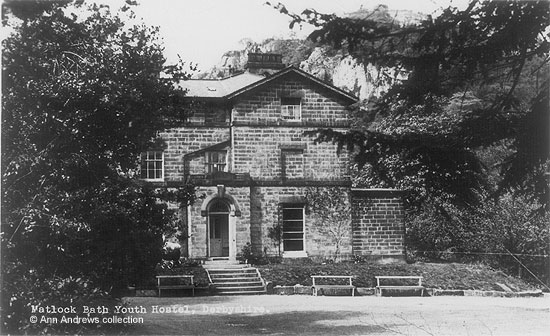 The former vicarage, 1955-60.
The study where several generations of Vicars had prepared their sermons was converted into a bar and the single storey extension on the right hand end was the Club's dining room. The web mistress remembers the grounds being decked out with bunting and stalls about 1953 for a summer fete involving the schoolchildren from Matlock Bath School who performed a series of Country Dances. In early 1956 it was taken over by the Youth Hostel association and catered for school parties, ramblers and walkers but then became a Probationary Service office. This postcard dates from its time as a youth hostel. The house is now a privately owned.
Some related images
|
|||||||||
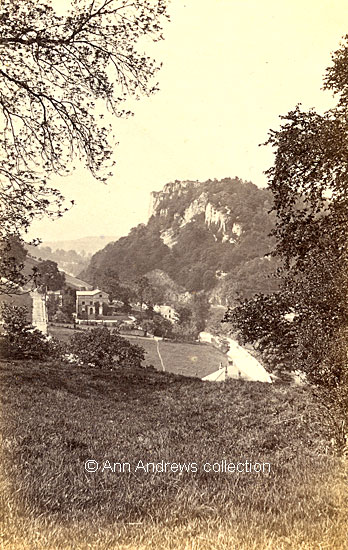
Images: 1 and 2. [Untitled] Matlock Bath [view of High Tor and Vicarage]. Published as a C.D.V. by John Latham. About 1880? The stereo view number is no 612 (this from Dr. John Bradley's Stereo World, Vol 30 no. 3). 4. Postcard published by YHA. Sent 2 Nov 1960 by a boy in a school party. He reported "We saw a lot of floods on the Tuesday. We got drenched. So far I have no fossils". Postcard in the collection of, provided by and © Ann Andrews. Information written, researched by and © Ann Andrews. Intended for personal use only. |
|||||||||
References (coloured links are to transcripts or more information elsewhere on this web site): [1] Reverend William Gibb Barker was listed as the Curate of Matlock Bath in the 1851 census. He became the incumbent in 1842 and his name is show as the first vicar at Holy Trinity on boards in the church. He was also listed in local trade directories : Bagshaw's Directory 1846 | Kelly's Directory 1848 | White's Directory 1852. The "Illustrated London News" of 3 December 1853 announced that he had received tokens of affection and esteem on his removal, after 10 years in Matlock Bath. [2] See the 1848 Tithe Map, Derbyshire Record Office. The Church Trustees of Trinity (Matlock Bath) owned the Parsonage-house and its Outbuildings, Yards and Gardens. [3] "Derby Mercury", 18 January 1854. Ecclesiastical Intelligence. Preferments and
Appointments. [4] "Derbyshire Courier", 28 February 1857. Accident and Narrow Escape from Furious Driving. [5] "Derbyshire Courier", 15 October 1859. Deaths. "On the 9nd [sic] instant, at Palermo Bay, the Rev. Edw. Singe, late incumbent of Matlock Bath, aged 61". His widow Emily died at Freshwater in 1881. [6] "Derbyshire Advertiser and Journal", 6 October 1865. Presentation
to a clergyman. [7] Derbyshire Times, 30 September 1871. Funeral of the late Revd. John Martin Maynard. MI of Rev. Maynard and his wife. There is also a tablet inside the church. [8] Rev. Pelly and his family are shown in the 1871 census. [9] "Derbyshire Times", 6 February 1875. Mentions Ram's departure and Latham's appointment. [10] "Derbyshire Times", 17 March 1883. Death of the Vicar of Matlock Bath. He had been ill for only eight days. Edward Latham Kelly's 1876 Directory | the 1881 census | his mi. [11] The Baker's had 6 children (from the 1911 census). They can be found in the following on-site records: the 1891 census | the 1901 census | his widow's MI. [12] "Derbyshire Advertiser and Journal", 16 May 1914. Rev Baker's last service. [13] "Derbyshire Advertiser and Journal", 10 April 1914. Presentation at Matlock Bath (to Rev. Baker). [15] "Derbyshire Advertiser and Journal", 10 September 1920. [14] "Derbyshire Advertiser and Journal", 22 April 1921. [16] "Derbyshire Times", 17 May 1924. Whist Drives and Dances. Rev. Davies was also shown in Matlock Bath in Kelly's Directory 1928. [17] "Derbyshire Advertiser and Journal", 28 June 1929. [18] "Derbyshire Times", 6 December 1930. Letter to the editor. [19] "Derby Daily Telegraph", 8 January 1934. [20] "Derby Daily Telegraph", 7 March 1935. [21] "Derby Daily Telegraph", Derby Daily Telegraph 30 January 1943. Matlock Bath Short of Boys. [22] "Derby Daily Telegraph", 1 September 1945. Vicar's Study is Now Bar. Later advertisements in the "Nottingham Evening Post" of 30 August 1946 and other newspapers. [23] "Derby Daily Telegraph", 12 September 1947. Stately homes of Parsons. |


 A full list of the incumbents can be found on the photographs of the wooden boards displayed
in Matlock Bath Church - see
A full list of the incumbents can be found on the photographs of the wooden boards displayed
in Matlock Bath Church - see 


