|
Images Index> Matlock Bath, 20th and 21st Century Images> This page |


| Matlock Bath: Grand Pavilion, Post War to Present Day |
| Matlock Bath : Twentieth Century Photographs, Postcards, Engravings & Etchings |
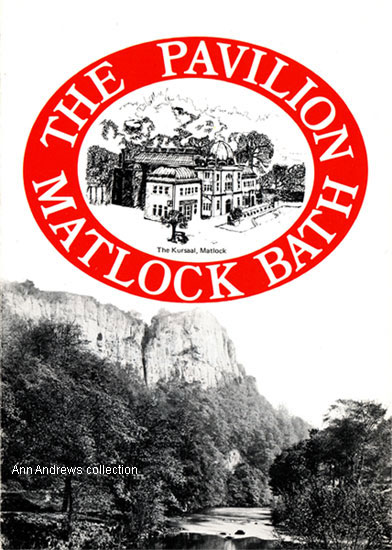
Front cover of a brochure for coach tours that began at the Pavilion (see below).
|
|||
Cllr. Remo Tinti was said to be jubilant in 1954 when a new dance floor, something he "had been working for since heavy Army boots made such a mess of it during the last war" was about to begin. It was said to be "perfectly smooth, dustless and practically everlasting". Quite a claim, and possibly not taking account the stiletto heels that were coming into fashion[3]. But in 1956 the Urban Council eased their liabilities by renting the bottom floor as a bookstore and then the Attractions Committee offered to rent the upper floor. The relaid floor in the large hall made the Pavilion one of the most popular dance halls in the district and where many locals met their future spouses. Matlock Council gave the Attractions Committee a five year lease[1]. It was, however, not the only dance venue in the Matlocks. In 1957 the Attractions Committee were informed that there had been a "shoal of applications" from outside organisations to run dances. Unfortunately, they were also reminded that an arrangement existed so the Pavilion did not compete with either Masson Mills [Welfare Centre] or the Royal Artillery at the Drill Hall. It limited them to just twenty-one Saturdays and holidays in the year, some of which were already used by other local events such as the Matlock Bath Musical Festival and the Miss Derbyshire competition (see below)[4]. How much longer these restrictions remained in place after that is unclear, but the Drill Hall closed in 1963. In the late 1950s my late father's firm was tendering for a contract to paint the outside of the Pavilion. One of my cousins, who worked for my father at the time, later told me that the long wooden ladders were put into the paddling pool — presumably closed for use — to swell them so that they would not slip when needed for the contract. My brother and I went to see our father there before work began, possibly when he was supplying an estimate for the work. We went up through the building to stand on the flat roof below the dome whilst my father walked up the dome to inspect the crown. He called down to us and we both went onto the dome itself, although were not courageous enough to go quite to the top. Very few people will have done that, either before or since, and definitely not children[5]. In 1969 Councillor Francis W. Boden suggested the UDC was like a landlord who had neglected his duties! He was referring to a clause from the then current lease to the Attractions Committee, as under this lease the Council was supposed to maintain the roof and the walls and keep the Pavilion in good repair. He added that in 1949, when a lease had been granted to the same committee, a rental of £200 was to be paid and the committee were to receive a penny rate, bringing in £450 at that time. A similar arrangement in 1969 would net about £2,500[6]. Income from bookings had declined alarmingly, which was attributed to the state of the building. To make matters worse, the four smaller domes were leaking[7]. Councillor Tinti announced in March 1970 that the UDC had agreed to major improvements at the Grand Pavilion, costing over £3500. However, the committee were to undertake the redecoration on do-it-yourself lines[8]. An extraordinary challenge for local people to take on when it ultimately was the Council's responsibility. The web mistresses late father donated some or all of the paint. After the Illuminations were switched on in June that year a ball, given by the Attractions Committee, was held to mark the Pavilion's re-opening after its face lift[9]. Unfortunately, at the end of the year came the announcement that Matlock Bath branch library, housed in the Pavilion's ground floor, was to close as only 193 residents were using it, sixty of them the local children. It had opened in the 1950s and was to be replaced by a weekly mobile library (or readers could catch the bus to Matlock to choose their books). At the time it was said that their departure would not affect Derbyshire County Council's use of the building as the space could be used to improve stocks of books in the county. However, in early 1976 West Derbyshire District Council announced several changes as the County Council was moving out. There was to be a mining museum of national significance and a tourist office on the ground floor as well as new central heating, supplied by two boilers[10].
Over the years the Pavilion staged numerous exhibitions, dances and live shows. The 1946 Industrial Exhibition was the first of many exhibitions held at the Pavilion. A Road Safety and Cycle Competition was staged at the 1955 Matlock and District Trades Exhibition. Special road safety name signs were to be erected at the main approaches to Rowsley and Cromford. Cycle dealers were also asked to distribute letters giving guidance on road safety principles as a result as Matlock Bath had many cyclists visiting at the time[11]. 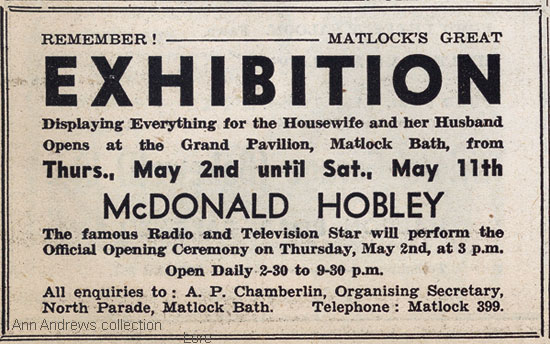 1957. Matlock's Great Exhibition (for the home) Advertisement. Three Chamber of Trade exhibitions were held here in the 1950s. The first, in 1955, was opened by the T.V. personality Mary Malcolm. McDonald Hobley followed her in 1957 and the T.V. comedian and panellist on "What's My Line" Cyril Fletcher did so in 1959[12]. A number of Antiques and/or Antiques and Curios Fares were held at the Pavilion in the late 1960s and 1970s. The one held in 1978 was described as the fourteenth held at the venue[13]. The Pavilion also hosted an exhibition for motor-cyclists in their "Mecca of the Midlands" in 1978. A special attraction for enthusiasts was advertised, with all types of bike and accessories, spares, equipment and clothing on display[14]. Matlock Bath's Carnival Committee decided to invite all the county's Carnival, Gala and
Well-dressing Queens crowned in the previous year to all-Derbyshire contest for the
"Miss Derbyshire 1950 contest". Both the eliminating rounds and the finals were
to be held at the Grand Pavilion in July that year. It was promoted by Swain's, who
ran the Derwent Gardens. The winner was to receive ten guineas, a week's holiday at
Skegness and a large trophy to hold for a year. She was also given a small cup which
they could keep. It is unclear when the event ended, but there were no more press reports
after 1993[15]. 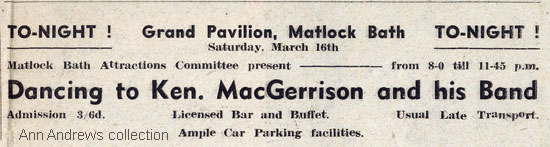 1963. Dancing to Ken MacGerrison and his Band[16]. One of many bands hired by the Attractions Committee over the years. However, in the Sixties young people largely wanted to dance to pop music rather than traditional ballroom
dancing. But the venue faced stiff competition from Buxton, where in the Beatles had played in 1963. The Kinks
and Manfred Mann were at Buxton in 1965, with coaches laid on from Matlock, although the latter group did visit
Matlock as they chose to stay at the New Bath Hotel[17].
Advertisement for their show, 15 July 1967. Georgie Fame, a well known and popular performer in the 1960s, was hired to play at the Pavilion mid-week in 1967 (see advertisement immediately above) but unfortunately only 380 people turned up. Whilst Fame managed to joke about it, and it was afterwards described as a "test" night to see if mid-week dances would be profitable, it was a poor management decision. They decided afterwards that there would be no more mid week dances[18]. Other musicians, who were booked for the Saturday evening performances, were more successful. Brian Auger and the
Trinity along with Julie Driscoll were there in 1966; the Cream (bassist Jack Bruce, drummer Ginger Baker and guitarist
Eric Clapton) played there in 1967; The Pretty Things and Long John Baldry performed at the Pavilion in 1968[19].
Advertisement for his show, 17 February 1968. Long John Baldry was born at Over Haddon but had subsequently lived in North London.[20] Peppers Machine had played with Jimmy James and the Vagabonds at the Pavilion on 31 December 1967.
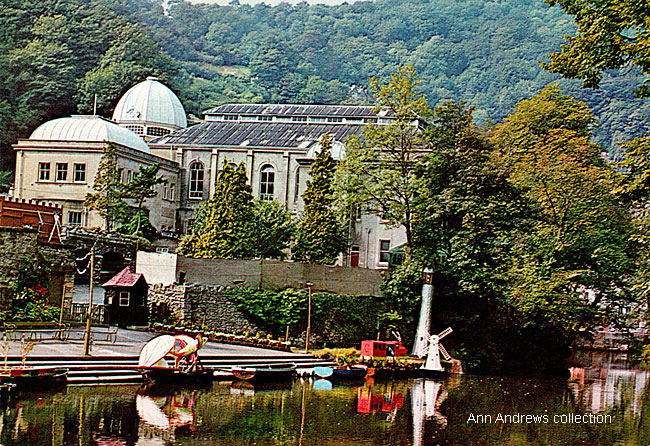 1970s. View from the river. The pavilion, the landing stage and boats decorated for a Venetian Fete. Notice the wooden barrier fencing to prevent people from sneaking a look at the boats before they were judged. If you know the subjects, names of the boats or who the boats had been built by on this occasion — please contact Ann. Phil and Sue Grey were "working 36 hours a day bringing everything into this entertainment complex" by 1978. They had taken the Pavilion's first floor over in 1974 and ran Country and Western Nights, brass band shows, discos featuring D.J.'s from local radio and star cabaret. The Pavilion even had its own clown called Plimsole! The Riverside Rooms had hosted everything from the World Championship darts final to ballroom championships and antiques fairs[21]. Phil brought in top household names to play and/or sing at the Pavilion over the years. Elvis
Costello, Ken Dodd, David Hamilton, Frank Ifield, Syd Lawrence, Ruby Murray, Mike Read and Blaster
Bates were just a few of the entertainers he had employed. He claimed the building was neglected
and run down when he took over from West Derbyshire Dales DC, which was undoubtedly true. He added
that "Discos are the in-thing and he recognised that the Pavilion was an important meeting
place for young people[22]." 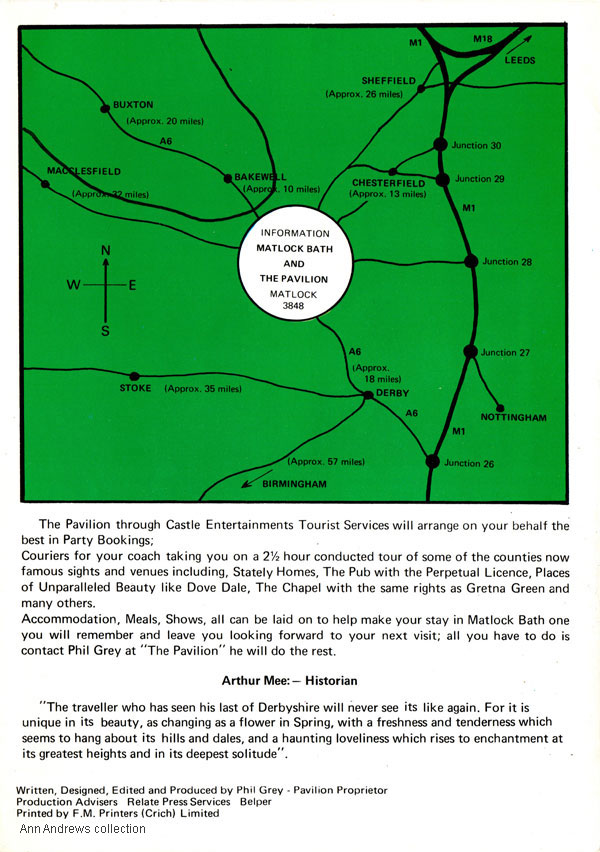 This is the back of a brochure for coach tours, organised by Phil and Sue Grey, that were available at the Pavilion. The front cover is at the top of the page. The Grey's 1990 upgrade was completed in three weeks, with the support of numerous local suppliers. Haydn Stanley provided floor coverings, joinery was undertaken by Frank Hammond of Chesterfield, Fletchers of Rutland Street did the decorating, Strange of Tansley installed electric lighting, Designline of Dale Road suppled decorative lighting and electrical fittings to name just a few who had given Phil Grey their support[22]." Phil Grey died very unexpectedly in 1993. Over 300 people crowded into St. Giles' to pay tribute to the
former nightclub host and district councillor who had run the Pavilion's entertainment centre for 19 years.
He was described by Rev. Peterken as "a man who dreamed impossible dreams and amazed everybody by making
at least some of them come true[23]." A band concert in
his memory was held shortly afterwards[24]. 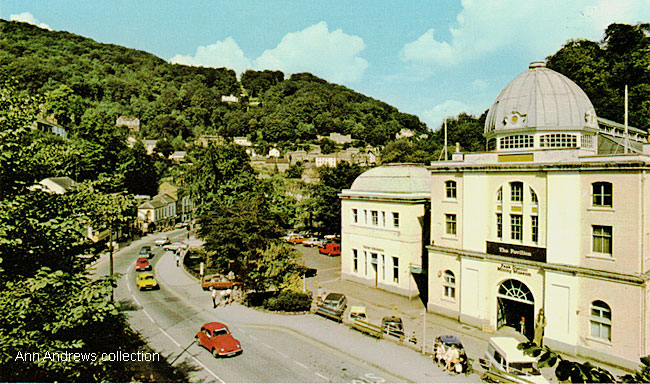 Tourist Information was available from the ground floor room on left hand side of the building. However, by 2001 there were complaints that it was cramped as a cash machine had been installed[25]. The entry to the Mining Museum was, and still is, through the main central doorway. The Mining Museum had opened on the Pavilion's ground floor in the early summer of 1878 with 150 exhibits and has proved to
be a great asset to the village. The driving force behind the project was the Peak District Mines and Historical
Society. Lead Mining and smelting was a major industry in the surrounding hills from very early times.  The Pavilion building and Fish Pond photographed during the winter of 2000.
In April 2001 scaffolding was erected around the edifice. The Pavilion had deteriorated over the course of the previous year, and this was an effort to restore the exterior before further work, on other parts of the building, was tackled[27]. A different correspondent had written to the local paper stating that "exterior masonry is crumbling and falling away and woodwork is rotting and lacks paint". He or she added that the building was "shabby, poorly signed and currently awash with water round the entrance"[25]. The Pavilion had a new lessee, Kevin Brough, and had been expensively refurbished as Brodie's Nightclub in 2001.
A black, 100 year old, Rud-Ibach piano, having been hidden under a dust sheet for twenty years at the
back of the stage, was re-discovered. It had been bought by the Attractions Committee in 1948 and was
used regularly until electronic keyboards became a popular alternative. When he ran the Pavilion Phil
Grey had the piano tuned regularly and his wife Sue had polished it. So Mr. Brough agreed that the new
cinema sized video screen on the stage could be lifted out for a charity show[28]
and the piano was to be used by the musicians. 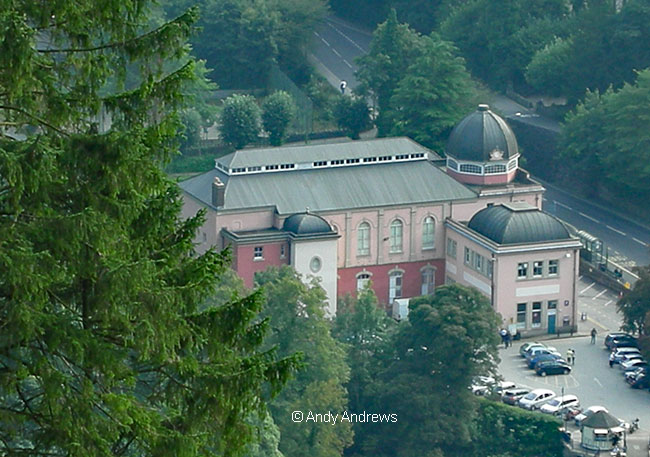 The Grand Pavilion from the Heights of Abraham, September 2008. The exterior had been painted! Another photograph taken on the same day can be found on Matlock Bath Today (2).
|
|||
1 and 5. "The Pavilion, Matlock Bath". Brochure published by Phil Grey promoting tourist tours from Matlock Bath. No date. 2. and 3. Advertisements from the Matlock Mercury, Ann Andrews collection. 4. "The River, Matlock Bath", Published by and © A. W. Bourne, 32 Babingley Drive, Leicester. Printed in England. Not used. In the collection of and provided by Ann Andrews. 5. "The Pavilion, Matlock Bath". Printed and Published by E. T. W. Dennis Ltd., Scarborough, No.23. Photocolour. All British Production. Not posted. Note on Back: Parked outside here 23/2/86. 6. Photograph of Pavilion from near Fishpond Hotel, 2000, provided by and © Ken Smith and scanned by Ann Andrews. 7. Photograph of the Grand Pavilion from the Heights of Abraham, 2008, provided by and © Andy Andrews. Postcards and brochure in the collection of and provided by Ann Andrews. © They are still within copyright. All images provided by Ann Andrews. Researched, written by and © Ann Andrews. Intended for personal use only. |
|||
|
[1] "Derby Daily Telegraph", 6 June 1956. Attractions Committee have tamed a "white elephant". [2] "Matlock Mercury", 17 May 1969. This was during a Matlock UDC finances and general purposes committee debate on expenditure at Matlock Bath. [3] "Derby Daily Telegraph", 14 July 1954. Work on New £300 Dance Floor begins. [4] "Belper News", Matlock Bath Pavilion. An Asset to the District. [5] Personal memory of the web mistress, which has been shared with very few people. I have photographic evidence of my brother on the dome, though not myself. [6] "Matlock Mercury", 26 Apr 1969. [7] "ibid.", 27 September 1969. [8] "ibid.", 7 March 1970. There was to be a work-in on the following day. [9] "ibid.", 18 Jul 1970. [10] "Derby Daily Telegraph", 26 February 1976. Future Plans mean changes at the Pavilion. [11] "Belper News", 24 June 1955. More Accidents in the Matlock Area. Are faster cars the cause? [12] "Derby Daily Telegraph", 19 March 1959. Chambers of Trade were made up of local business people. Mary Malcolm was photographed at a local shop when she visited the Matlocks in 1955. See One Man's Photographic Memory (Harry Gill). [13] "Derby Daily Telegraph", 18 March 1978. [14] "Matlock Mercury" 17 April 1987, Motor-cycle exhibition at Pavilion. [15] Derbyshire Times, 10 March 1950. Carnival Queen's of Derbyshire. Searches of on-line newspapers show no more newspaper reports of the event after 1993. There is a photograph of the 1961 Miss Derbyshire on Matlock Bath: Venetian Fete (now Venetian Nights), decorated boats. [16] "Matlock Mercury, 2 March 1963. [17] "ibid." 21 August 1965. [18] "ibid.", 15 & 27 July 1967. [19] "ibid.", 11 Feb 1967 - advert for The Cream to play Sat 11 Feb; 17 Dec 1966 - Julie Driscoll and Brian Auger and the Trinity to play same day; 10 May 1968 - Pretty Things - were reopening by popular demand. [20] "ibid." Long John Baldry's show was advertised on 13th Jan, 10th February, 17th February and 24 February 1968. Although he had been accompanied by Reg Dwight (later Elton John) and Rod Stewart in the past, neither of them appeared in the billing for the event at the Pavilion. [21] "The Stage", 11 Aug., 1977. Derbyshire Diary. Phil was a former cabaret star. [22] "Matlock Mercury", 29 Jan 1993. Crowds at final tribute for Phil Grey. [24] "ibid", 19 March, 1993. Advertisement for the event. The Darley Dale Band were to play. [25] "ibid", 1 February 2001. MM, 1 February 2001. Call to repair Matlock Bath's Pavilion. [26] "ibid", 9 Nov 2000. Postbag. [28] "ibid", March 2001. Taking a step back in time at Matlock Bath's Pavilion. [27] "ibid", 5 April 2001. Revamp scheme to save the Pav. |