|
Images Index> Matlock Bath, 20th and 21st Century Images> This page |


| Matlock Bath: The Grand Pavilion, 1930s |
| Matlock Bath : Twentieth Century Photographs, Postcards, Engravings & Etchings |
|
|||
For ten days in April 1931 Matlock Chamber of Trades held a home, industry, and fashion exhibition, which was attended by 5,000 more people than were expected. It included an exhibition of reptiles and animals by the explorer Major Sarlls which proved to be very popular with local schoolchildren who were given free admission on the first day. There was even a ladies day which was opened by the Marchioness of Hartington[2]. Her husband had been due to open the event but was unavoidably detained by Parliamentary affairs, so his brother in law deputised. Attendees were encouraged to Buy British, which was deemed to be very important at that time. However, at the end of the year Council members expressed their concern about both Pavilions and Mr. W. Jacques said there was no inside place of amusement for residents or people in the surrounding district. Both he and L. G. Wildgoose thought that Matlock Bath needed livening up, considering it high time both Pavilions were advertised although the latter observed that it was no use surrounding possible lettings of the Grand Pavilion by so many restrictions that nobody would want to use it[3]. The Operatic Society booked the Pavilion for a performance of "The Yeomen of the Guard" in 1932 as they were unable to use the Cinema House in Matlock, but lost £63 18s. 4d[4]. Whether this was because the venue was unable to hold enough people is unclear. Plays were also performed. For example, in 1934 the Matlock Bath Amateur Players presented "The Whole Town's Talking" in front of an audience of about 500 people[5]. The building was also used for balls, and at least three police balls were held here in the 1930s[7]. The postcard above has the words "Grand Pavilion Theatre" written above the main door and "Picture House" is at the top of the two arched recesses beside the door and glass cases showing what was on and pictures of the stars. Film shows, which began in the late 1920s, restarted in 1932 after a break of almost two years; the then proprietor of the Pavilion Cinema invited old-age pensioners living within a five-mile radius to visit the cinema free of charge on Tuesdays[7]. In 1936 Matlock Cinemas, Ltd. leased the Grand Pavilion from Matlock Urban Council. The lease stipulated that the cinema company should "provide high-class entertainment at suitable times," and the building would be open on Sundays[8]. The postcard shows happier times in the 30s. A couple of coaches were in the Pavilion's car park and people were clustering round the fish pond, undoubtedly admiring the fish. Cycles were propped against the kerbside. Cycling to Matlock Bath was very popular, and continued to be so after the War. Cyclists would travel with members of their particular club from other parts of the county, eat an egg and chip tea (with bread and butter) in one of the cafes that catered for cyclists and return home the same day. However, in 1936 the Parochial Church Council were considering that "steps should be taken to control the increasing tendency to indecent dress in the street on the part of female cyclists and others[9]." 
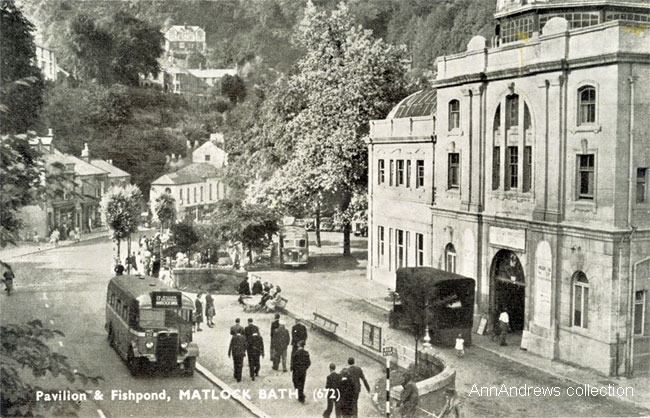 The bus near the stop on the main road was probably one of the local fleet, delivering passengers to Matlock Bath. However, a second bus is in the Pavilion car park had almost certainly taken tourists to the village. I have been unable to find why so many well dressed men were walking towards the Fishpond. Two of the group are wearing white flat caps, so may have been drivers or conductors. There is also a large delivery van outside the main door of the Pavilion but its load is unclear. |
|||
1. "Matlock Bath", No58.137_. Not posted. In the collection of provided by and © Christine Leila Hill. 2. "Matlock Bath, Derbyshire. Published by R. Sneath", Paradise St., Sheffield, No.6321. Posted in Matlock on 3 Sep 1936. In the collection of provided by and © Ken Smith. 3. "Pavilion & Fishpond, Matlock Bath", Copyright publication by Simpsons the Printers, Friar Gate, Derby (J W Simpson & Sons Ltd). No.672. Unused. Stamp Box - 1d. Stamp, if with only five words conventional greeting. Researched and written by and © Ann Andrews. Intended for personal use only |
|||
|
[1] "Alfreton Journal" The Matlocks' Progress. Chairman Reviews the Work of the Urban Council. Also "Derbyshire Times", 2 August 1930. [2] "Derby Daily Telegraph", various reports on 16, 17, 21 and 27 April 1931. [3] "ibid.", 15 December 1931. Matlock Bath and its Pavilions. Derelict condition alleged at Council meeting. [4] "ibid.", 3 February and 20 October 1932. [5] "ibid.", 12 April 1934. This was a three-act comedy. [6] "ibid.", 6 March 1936. The ball that year was the 18th annual ball and was arranged by Matlock and district police officers in aid of the Derbyshire Constabulary Widows and Orphans. Police balls were also held at the Pavilion in 1932 and 1934. [7] "ibid.", 3 May 1932. [8] "ibid.", 5 May 1936. Matlock Grand Pavilion Lease. When the lease was signed part of the building was expected to be used as a cinema and part as an amusement park. [9] "The Daily Independent",19 August, 1936. Is Matlock Bath one
of our most " Wicked Spots?" Clothing of Girl Cyclists. Authorities Accused of Allowing Outrages.
Accusations of outrage to common decency were reported as being allowed by the Council. |


