|
Images Index> Matlock Bath, 20th and 21st Century Images> This page |


| Matlock Bath: The Grand Pavilion, 1938 |
| Matlock Bath : Twentieth Century Photographs, Postcards, Engravings & Etchings |
|
|
||||||||||||
The coaches parked in the Pavilion's car park had brought the day trippers to Matlock Bath and had been a familiar site in the village for many years. It is amazing to see just two vehicles on the main road (A6); these days the road is extremely busy. The rooftops closest to the camera would have been Lusby's
sweets and tobacco shop, run by Nellie Lusby and her daughter
Edna (the taller building with the two dormer windows), the
newsagency of George Barker and the grocery shop of Alice
Finney (her husband was a house painter). 
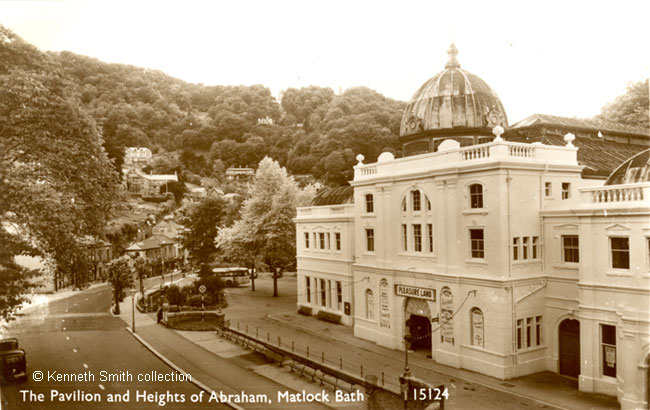 By the late 1930s the Pavilion had become Pleasure Land. From the many signs on either side of the door we learn that admission to the Pavilion was free.
The Council made its money from a Rifle Range, bumper tables, darts, football, skini? balls, gun
shooting and rotating machines. Not all the attractions mentioned on the advertising boards are
easy to read on this card, but the public could also buy ices. A large weighing nachine was just
inside the entrance, on the left hand side. But where was the entrance doorway? Perhaps it was folded away.
When the Army returned to Matlock Bath, the whole of the Pavilion's ground floor became a
kitchen for their training camp[5]. |
|||||||||||||
1. Postcard, "Matlock Bath" published by Valentine & Sons Ltd., Dundee and London, Throughout the World Series No.G 9650. Unposted. Card registered in 1938. In the collection of © Ann Andrews. 2. "Fish Pond and Pavilion, Matlock Bath". Mat. B. 40. In the collection of, provided by and © Susan Tomlinson. 3. The Pavilion and Heights of Abraham, Matlock Bath. A Copyright Postcard, No.15214. Published by J. Salmon of Tunbridge Wells. Information written, researched by and © Ann Andrews. Intended for personal use only. |
|||||||||||||
| References:
[1] "ibid.", 28 October 1938. Increases in takings at Matlock. [10] "ibid.", 25 September 1939. Matlock Council meeting. [3] "Derbyshire Times", 8 September, 1939. [4] "Derby Daily Telegraph", 25 September, 1939. [5] (2012) Taylor, Keith "The Matlocks and District in the Second World
War"... See Books & Other Publications (scroll down). |


