|
Images Index> Matlock Bath, 20th and 21stC Images> This page |


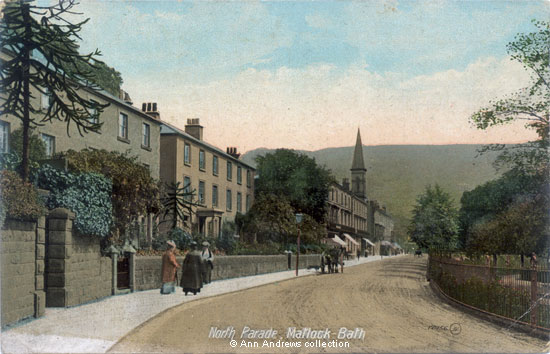
| North Parade, Matlock Bath, 1908 |
| Matlock Bath : Twentieth Century Photographs, Postcards, Engravings & Etchings |
|
|
||||||||||||||||
The railings on the right were ostensibly to protect those strolling along the Promenade although in reality they were designed to keep people out. They had been installed over the winter of 1905-6, following the Matlock Bath Improvement Act coming into force[1], and are higher and more ornate than those placed along the roadside when the Promenade was first developed (see The Parade, 1902-05). Some of the Fountain Villas properties were either boarding or lodging houses whilst others were private homes. During the 1870s and 1880s Helen Elizabeth & Frances Julianna Peall ran a "ladies' school" in one of the houses No.3)[2] and a few years after this card was posted Miss Fanny Picken, the principal of a girls' school, was living at No.1. Amongst the people living here in 1908 were Mrs. Elizh Bridgett, Mrs. Elizabeth Robinson —she later moved to Brunswood Terrace—Miss Annie Lymn and Frederic Charles Lymn. Mr. Lymn was the solicitor & commissioner & clerk to Matlock Bath & Scarthin Nick Urban District Council[3]. Today these properties have a lovely view of the river and Lovers' Walk on the opposite bank. The newer railings, installed after the road was widened, are also considerably lower. Several Monkey Puzzle trees or Chile pines (Araucaria araucana), which are native to the Southern Hemisphere, were and still are grown in Matlock Bath. Of the two trees shown in the top picture, the larger one is no longer growing but the other tree remains, with two further specimens close by[4]. There was another on the Promenade near the War Memorial. Although this second card, below, was posted not long before the first war, the image for it was taken at almost the same time as the first picture. The young monkey puzzle tree in the front garden, for example, is the same height. 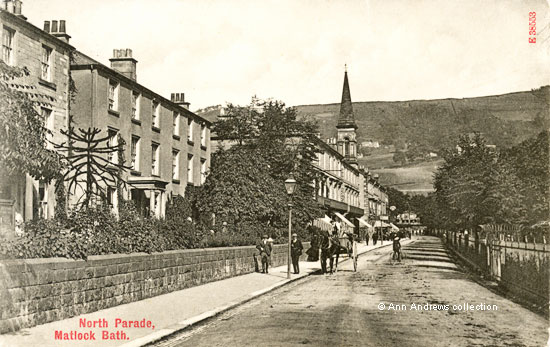 Interestingly, the horse and cart are in almost the same position, too, which could suggest this was a stopping point. However, it is more likely to have been someone delivering goods to one of the houses or possibly someone who lived in one of the properties. The vehicle's driver is standing, but bending over as if disembarking, and behind him is a tarpaulin or cover; the fact that his sleeves were rolled up probably indicates that he was delivering goods. The men were all wearing the flat caps and the male on the pavement, standing next to the wall, was wearing long boots and riding breeches. He could have been a cab driver. The street lamp would have been lit by gas. We can see the new metal railings and gate fencing more clearly on the second card. Presumably the lethal looking spikes above the gateway were to prevent unwanted visitors from clambering over the railings and gaining free entry. Finally, a large group of people are clustered round the shops further along the Parade, past the church, almost as if they are the first batch of day trippers off the train on a Bank Holiday outing to the village. Some are also in the roadway, possibly crossing the road from Station Approach. |
|||||||||||||||||
|
Images: 1. "North Parade, Matlock Bath". Valentine's Series, Famous Throughout the World - No.17456 (IV). Printed in Great Britain. The card was posted in Matlock Bath on 3 May 1908. It was sent to Miss Blacham at Chesterfield from L Exford, probably Laura Exford who was born in Chesterfield and living there in 1901. "This view is just above my shop". Presumably she had a shop somewhere along North Parade. 2. "North Parade, Matlock Bath". Published by O. F. (Stengel & Co., Ltd.) Post Card Publ., London N, No. E 38553[5]. Posted on 2 Jul 1913 at Bridlington and sent to Miss Brown at Chesterfield. Message not relevant to image. Postcards in the collection of, provided by and © Ann Andrews. Researched, written by and © Ann Andrews. Intended for personal use only. |
|||||||||||||||||
|
[1] Following the Royal Assent being given to the Bill, the Matlock Bath Improvement Act became law on 4 August, 1905. The Council were then to charge an entrance fee for non-resident visitors to the Promenade. [2] See references to them in the 1871 census | the 1881 census | Kelly's 1876 Directory. Also see Matlock & Matlock Bath Public Notices & Announcements, 1867. [3] "Kelly's
Directory of Derbyshire" (1908) pub. London [4] The monkey puzzle trees of today - one is next to the tree shown in this picture and another in the next garden. [5] It has proved quite difficult to find out much about the
publisher Stengel & Co. but the London Post Office Directory of 1910 [Vol. II. Part 1:
Trades & Professional Directory] shows an O. Flaminger or Flammger of South works,
South Tottenham, North London and in London's 1915 Post Office Directory the same name
appears as a Fine Art Printer of Fleet Street. |