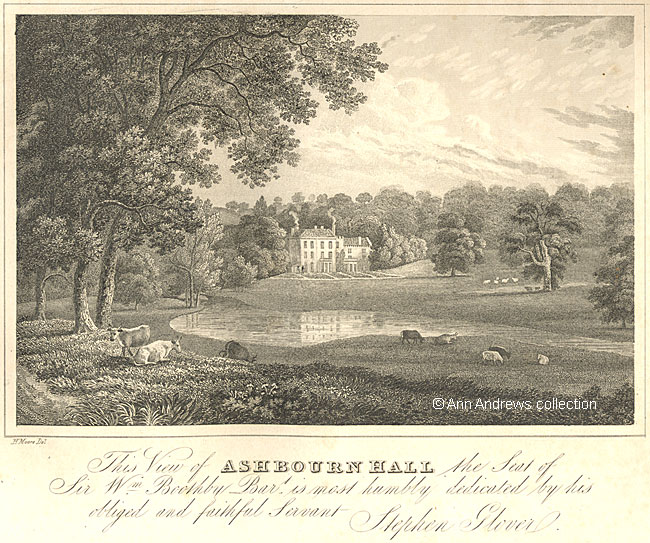
Ashbourne Hall had once been and was "for several generations the property and residence of the
ancient family of Cokaine, who has several considerable estates in the county". Their pedigree, published
in Glovers "History of Derbyshire" records William Cockayne, son of Andrew Cokayne of Ashbourne,
living in Ashbourne in 28 Edward I[1]. He adds that "their
continuance here may be traced from the time of Henry the Third"[1].
Below is part of an inscription about Thomas Cockain, who was knighted by Henry VIII, that is in
the parish church[2]:
"Two goodly houses did he build to his great praise and fame
With profitte greate and manifold belonging to the same.
Three Parkes empaled eke wherein to chase his deers,
Aloft the Lodge within this Parke he also builded here.
He did his house and name renew and eke his land restore,
Which others had by negligence decay'd in tyme before."
Sir Aston Cokayne may have delivered the final blow to the family finances, but the Cockayne
inheritance had been in decline since the reign of James I (d. 1625).
Aston, who was the author of several dramatic and other poems in the reign of Charles I",
was the last Cockayne to own the property. He was born in Elvaston, the son of Thomas Cockayne and Anne,
daughter of Sir John Stanhope[3]. He had been well educated,
attending both Oxford and Cambridge Universities before embarking on a European Tour[4].
He resided chiefly at Pooley in Polesworth, Warwickshire, which he had inherited after his father's death before
the start of the Civil War.
A staunch Catholic, Aston was knighted by Charles I and provided considerable financial support for
the Royalist cause in the English Civil War, which is said to have ruined him[5].
However, his father's death at Gray's Inn Lane - under the name of Mr. Browne - undoubtedly placed a large
financial burden on his shoulders as he became responsible for the upkeep of Ashbourne Hall and Pooley and,
presumably, the maintenance of his mother. He also had to provide dowries for both his sisters and his daughters.
He did not live in Ashbourne Hall until his mother died in 1664[6].
Indeed, it was Dame Anne who invited Charles I to Ashbourne Hall, not Aston as he was elsewhere at the time.
"In 1671 he joined with his son, Thomas Cokaine, Esq., the last heir of the male branch of the family,
in the sale of Ashborne Hall and other estates to Sir William Boothby, Bart."[3].
Sir Aston Cockaine died at Derby in 1683/4 [7]; his son Thomas
had pre-deceased him and his wife Mary (nee Kniveton) was buried at Pooley a few months before him. He was
survived by two of his daughters[7].
"Ashbourne Hall subsequently became the seat of Sir Brooke Boothby, of Broadlow Ash". When Charles
James Stuart, the Young Pretender, marched to Derby in 1745 he and his officers stayed at Ashbourne Hall.
According to Glover, Sir Brooke and his wife were driven from the hall by the advance of Stuart's
army[1]. He added that the names of those of the invaders
who were to occupy the rooms were chalked on the doors; the chalk was afterwards painted over so the
names were preserved. Some of those doors were still in the Hall in 1833. "The bed in which he
(i.e. the Young Pretender, slept was also still preserved[1]"
Pilkington described the Hall in 1789. "He [Brooke Boothby] has made and is still making considerable
improvements in the house and grounds about it. It stands in a beautiful valley, and the situation, independent
of the ornaments of art, is admirable, and delightful[8]
The Hall briefly became the property [and seat] of Sir William Boothby, of Edwinstowe and in 1817 Richard
Arkwright was living at the Hall[3]. Sir William's son was the last
of the Boothby family to live at Ashbourne Hall; he died in 1846 and his eldest son succeeded to the baronetcy.
William Boothby's widow, an actress also called Mrs. Nisbett, died in 1858[9]
"Nottinghamshire Guardian", 23 October 1846.
ASHBOURNE HALL, DERBYSHIRE.
MESSRS. HOGGART and NORTON beg to inform the
public that Ashbourne Hall, the Residence of the late Sir
W. Boothby Bart, advertised to be Sold on the Premises in
Lots on Wednesday, October 28th, has been DISPOSED OF
by Private Contract.
Broad-Street, London, October 19." |
Just over a fortnight after this notice about the sale was published, the hall was again on the
market, this time divided into a number of lots. The printed particulars and plans hadn't even been
prepared[10]. The manor was eventually purchased in
1853 by a Mr. Craddock, and the Hall, with about 90 acres of land, by Capt. Fredk. Holland, R.N.,
in 1852[11].
Captain Holland died in London in 1860 at the Victoria Hotel in Eaton Square. The Hall next became the home
of the Frank family, who came from Lancashire. Robert was a barrister at law and died there 1883. His widow, Harriet
Elizabeth, died at Buxton and was interred at Ashbourne in June 1898[12].
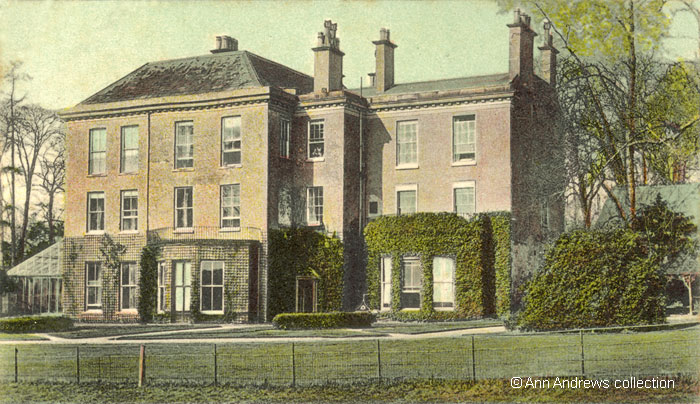
Ashbourne Hall Hotel, early 1900s.
Not all of the building remains today. The section on the right, with the large ivy-covered bay window, has an
Ashbourne Hall sign above it. The three storey section next to it is part of the same property. However, only
the two storeys of the left hand half of the building remain today. It now has a flat roof.
In February 1900 it was announced that Ashbourne Hall Hotel was to be opened on 26th March. It was to be a high-class hotel
and the proprietor was William Prince, formerly of the Isaac Walton in Dovedale[13].
On 27 June 1902 a public luncheon was hosted here on to mark the Coronation of King Edward VII[14].
In early 1910 Mr. Prince applied for the hotel's licence to be transferred to William Hobson Smedley, the hotel's
managing director[15].
J. C. Cox briefly mentioned the Hall in his 1913 guide as being "at the east end of the town, in a
small wooded park", which can be seen on two of thse images He added that the malt-house/chapel —
referred to in the inventory of Dame Anne Cokayne's Will[6]
— had been pulled down by Sir Brooke Boothby in 1785[16]".
In the summer of 1915 some 430 men of the 14th Battalion Sherwood Foresters arrived in Ashbourne. They were on a recruiting march
through Derbyshire and Staffordshire and were accommodated in the hotel's grounds. Sleeping quarters were provided by the Hotel
and the Town Hall. They departed the following morning, to be followed by the 145 company, Royal Engineers who arrived from Buxton.
The REs were to sail for the front in early September[18]. Later that year the
trustees of the late Mr. W. R. Holland announced that the hotel was to be sold by auction [19].
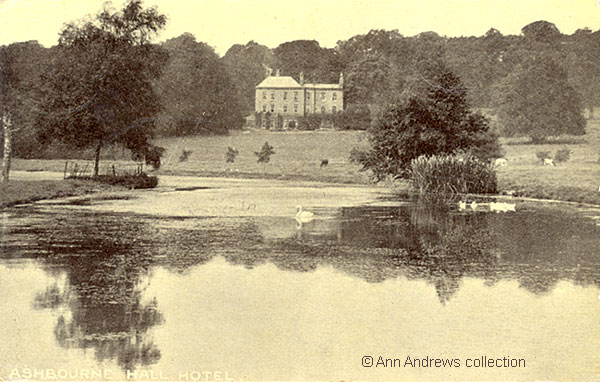
The lake had been created by the Boothby family and was formed by installing a number of weirs to hold
back the water of the Henmore Brook. Skating on the pond was advertised in January 1903 [17].
In the spring of 1910 the hotel advertised good sport as there was trout in the Hall pond. "Over a mile of fishing
available in a good trout stream — the Henmore — together with the Ashbourne Hall pond and fishing
free to their guests".
"Derbyshire Advertiser and Journal, 10 March 1917.
TIMBER FOR SALE.
ASHBOURNE HALL ESTATE, DERBYSHIRE.
VALUABLE LOT OF TIMBER FOR SALE,
IN TWO LOTS. BY TENDER.
Lot 1.—20 Chestnut, 8 Beech, 37 Sycamore, 14 Elm, 2 Ash, 9 Lime, 6 Silver Birch, 5 Hornbeam.
Lot 2.—24 Ash, 19 Elm, 1 Poplar, 1 Sycamore. 1 Oak.
Lot 2 are trees that are felled and trimmed.
There are some very fine Sycamore and Ash included in the Lots.
The Lots will be shown and Conditions of Sale may be seen by arrangement with the undersigned, by whom tenders will be received up to March 23rd, 1917.
MR. R. COATES, Sandycroft, Ashbourne.
|
The above advertisement partly explains why Ashbourne Hall is seen surrounded by trees on these images,
but by the 1920s there were few trees left within or around the property. See the next page.
Unfortunately, shortly after WW1 a German field gun and its carriage that had been captured "by
gallant Midlanders" at Bellenglise St. Quentin Canal in 1918 and presented to the town as a war trophy,
was briefly placed outside the town hall. One night some locals, taking issue with the fact that it
was of German origin, decided to throw it into the lake. It was a wet night and extremely muddy.
So the malcontents returned the following day to finish the job[20]!
Not all ex-servicemen supported the action by their former military colleagues.
A portrait of Aston Cockaine, taken in 1637 when he was aged 37, was bought for the school from Cavendish, Hood &
Co. by Donald Kimmins in 1952. Mr. Kimmins realised its importance and appealed for help in purchasing it.
"It is a genuine 17th century canvas by Thomas Leigh (mentioned in Bryan's Dictionary) and shows Sir Aston
nearly full face—head and shoulders in black silk coat with slashed sleeves and elaborate lace collar.
He has long curly fair hair, large moustache and a wisp of a beard. It was painted in 1637 when Sir Aston was
aged 28 years" [21]. After the Mansion was sold it was under
the protection of the Old Trust, who subsequently sold it along with a portrait of his wife Dame Mary. Since
then it has had two further owners.
The web mistress was, some years ago, in contact with a lecturer from the University of Wales, who was
researching the works of Thomas Leigh, a British artist, for that establishment. A short while later she corresponded with the
picture's then owner, who had the portrait professionally cleaned and was able to verify its provenance.
Leigh's signature came to light as a result. It had been previously invisible. Another possible
portrait was published in an article about Aston some years ago. The subject was wearing similar clothes, which
would have been fashionable at the time, but that gentleman had dark hair and does not resemble Aston.
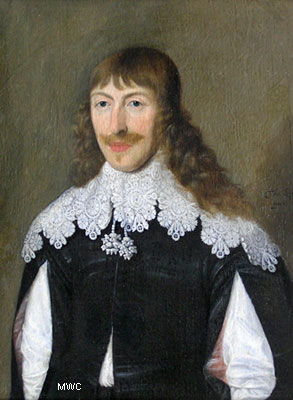
Thomas Leigh's portrait of Aston Cockayne as a young man.
There are numerous documents held by the National Archives that relate to Sir Aston Cockaine and his family,
including:
YHL/PO/JO/10/1/310A "4 February 1662 — Draft of an Act for the
sale of some of the lands of Sir Aston Cokaine, Baronet, and Thomas Cokaine his son, and the settlement of
the rest. Read 1 this day. The Bill was committed, but not further proceeded with. Lords Journals, XI. 377,
etc.[22]
Venn provides the following information about his time at Cambridge:
COCKAYNE, Aston. Adm. Fell.-Com at Trinity (according to G.E.C.. not found) c.1624. S. of Thomas.
B. 1608, at Elvaston, Derbs. Created Bart., 1642. Buried at Polesworth Derbs. [sic] Feb. 18,
1683-4[23].
Other pages relating to the Cokayne family, their former home or visitors To Ashbourne Hall.
 Ashbourne Charters and Early Deeds.
Documents from the Middle Ages relating to Ashbourne, DBY. Extracted from "Derbyshire Charters in Public and Private
Libraries and Muniment Rooms." Compiled by Isaac Herbert Jeayes.
Ashbourne: Poems about a Derbyshire Town.
It includes an epitaph by Edward Manlove upon the death of the Right Worshipfull Anne Coakaine, widow, who
died in 1664. There are also several epigrams and epitaphs written by Sir Aston about his family.
Ashbourne images relating to the Cockayne family or the Hall
More about Derbyshire that includes Ashbourne information:
Derbyshire's
Parishes, 1811
The
Wolley Manuscripts, Derbyshire for more about Derbyshire deeds, pedigrees, documents and wills.
Kelly's Directory, Derbyshire,
1891 - Ashbourne, part 1. History, churches, schools, councils, etc.
Kelly's Directory, Derbyshire,
1891 - Ashbourne, part 2. Private Residents and Commercial properties.
Portrait
of Brooke Boothby, 1871, by Joseph Wright of Derby, is in Tate Britain. This links to an external website.
|
References:
[1] Glover, Stephen (1833) "The History and Gazetteer of the County
of Derby ..." Edited by T. Noble. pub. Derby and London.
[2] Cox, J. Charles (1877) "Notes on the Churches of Derbyshire Vol II", p.385.
[3] This from Lysons, Rev Daniel and Samuel Lysons Esq. (1817) "Topographical
and Historical Account of Derbyshire" London: Printed for T. Cadell, Strand; and G. and A.
Greenland, Poultry.
[4] Aston Cokaine of Ashbourne, Derbyshire was granted a three-year travel
pass dated 12 July 1632 (TNA ref: PC 2/42/276).
[5] Supporters of the Royalist cause had to pay large fines.
[6] Will of Dame Anne Cockayne (nee Stanhope), 1664, written 16 August 1664,
inventory 2 September 1664. Probate Lichfield. Anne mentioned her son, but not by name, giving him a ffether bedd and items of bedding.
Her "beloved grandchild Thomas Cockayne" was bequeathed her family bible and other items. She also mentioned her
daughters, both living and deceased. She wished to be buried at the church between two daughters who had predeceased
her, if she would fit into the space! Another daughter, Mrs Katherine Weston, was left "my vellore carnation pettieste[?]
wth silver lace". The inventory showed the hall was very large for the time, with its own chapel
and brew house. She did not bequeath the hall to anyone as she did not own it. It had passed to
her son Aston following the death of his father before the Civil War.
[7] Will of Sir Aston Cockaine, 1863/4 March 24. Bt. Derby or Pooley War.
Probate Lichfield. The Will itself was written and witnesses in Derbie [Derby today]. He named his two
daughters, who survived him. The Inventory was praised and valued by Mr Byron Stanhope [not Bryan Cockayne],
Gil Swift and John Leeke. [This date used the old church calendar; he actually died in 1684]
[8] Pilkington, James (1789) "A view of the present state
of Derbyshire; with an account of its most remarkable antiquities; ... ", pp.279-280
[9] "London Evening Standard", 19 January 1858. Born 1812.
She had returned to the stage for a short while after her husband's death.
[10] "Derbyshire Advertiser and Journal", 9 October 1846.
[11] "White's Directory", 1858.
[12] "Lichfield Mercury", 22 June 1898.
[13] "Derbyshire Advertiser and Journal", 17 February 1900.
[14] "Ashbourne News Telegraph", 13 June 1902.
[15] "ibid.", 23 January 1903.
[16] Cox, John Charles, (1915, 2nd edition, revised), "Derbyshire" -
Illustrated by J. Charles Wall, Methuen & Co., London. Cox was then Rector of Holdenby, Northampton.
[17] "Ashbourne Telegraph", 28 January 1910.
[18] "ibid.", 20 August 1915. Sherwoods
and Royal Engineers' Visit.
[19] "Ashbourne News Telegraph", 5 November 1915.
The sale notice included about 149 acres, house with stabling, farm buildings and grounds;
Boothby Farm.
[20] This was reported in numerous newspapers, both local and national, of the day.
"Ashbourne Telegraph", 18 June 1920 was just one daily paper to report this.
Rather unfortunately, years later Porter's "Spirit of Ashbourne", which has an excellent
photo of the gun being rescued from the pond, reported an inaccurate account by claiming the gun was
hidden there when there was a threat of invasion. There was no threat of invasion at the time and
the gun wasn't hidden. Part of it was sticking out of the water! The park in the book's photo
was undeveloped; if, as was claimed, it had been taken there after WW2 the park's grounds would
have been landscaped (see next page).
[21] "Ashbourne Telegraph", 26 September 1952
[22] See Discovery
at the National Archives.
[23] Venn, J. A. "Alumni Cantabrigienses; a biographical list of all known students,
graduates and holders of office at the University of Cambridge", pub Cambridge University Press.
|