|
Images Index> 18th & 19th Century Images> This page |


| Matlock Bath: Ashfield, previously The Villa |
| Eighteenth and Nineteenth Century : Photographs, Postcards, Engravings & Etchings |
|
|
|||||||||||||
"The Villa, once called the Old Bath-house, was built on one of the more level plots of ground in the Dale, about 300 yards to the north" of the Old Bath Hotel site and provided somewhere for the visitors to stay until they became too numerous.The Old Bath site was developed in Smith and Pennel's time, when they bought the lease from Wragg, and the bridleway between the two properties was improved[4]. In the middle of the 19th century The Villa was a board and lodging house and was run by John and Elizabeth Broadfoot for over 20 years[5]. They were living in Matlock Bath by 1835[6] and had moved to The Villa by 1838 as they are mentioned in the first edition of "Gem of the Peak": "Mr. Broadfoot's, in the Villa Field, lately fitted up, with good stabling, and lock up coach house. ... The way to it is through the iron gates, just above Britland's"[4]. They advertised in trade directories throughout the 1840s and 1850s, continuing to advertise until 1864[7]. Their daughter Mary was also with them in Matlock Bath until her marriage to John Richardson at St. Giles' on 14 Dec 1854. Elizabeth Hind Broadfoot had been a member of Glenorchy Chapel and can be found in their membership lists[8]. Unfortunately, like a number of local businessmen, John Broadfoot encountered financial difficulties so the couple left Matlock Bath and moved to Southport[9] where John died in 1870. After her husband's death his widow moved to Sale to live with the Richardsons. She died in 1891 and was buried at Chapel En Le Frith on 24 Apr 1891.  The building had been used as a school for at least ten years before the Broadfoots moved in as Sarah and Jemima Cox ran a ladies boarding establishment at the house[10]. Mrs. Richard Coates followed on from the Broadfoots but it is unclear who was here in 1881 as the Matlock Bath census enumerator did not record proper addresses[11]. In 1891 John Wright, the headmaster of Trinity middle school, was in residence[12]. The house became known as "Ashfield" towards the very end of its life, the name shown on the advertising card above and below. In 1892 this substantial property was advertised for letting[13] and was described as being "delightfully situate, and commands charming views of the High Tor and the valley of the river Derwent". As well as the main house, the property had a "Cottage, Stable, Coach House, good garden, and Paddock adjoining" in grounds of over an acre. There was also a cow house with over 4 acres of land and a "small Lock-up Shop, for some time occupied as a butcher's shop". The Stones family were the last to live here and must have renamed the property; they were recorded as living at The Villa as late as 1899, although the 1901 census shows them as being at Ashfield[14]. The house was demolished in 1908. It seems a sad end for such an historic property. 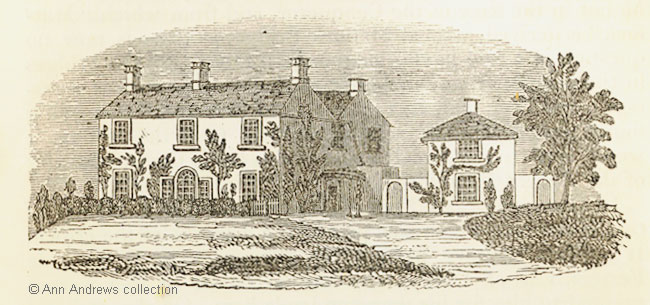 This charming engraving, which provides a good view of the front of the house, with the cottage alongside, dates from Mrs. Broadfoot's time. She managed a board and lodging house with "most comfortable accommodation" for visitors. Horses and carriages were available to hire. It was first published by Adam in 1845 and appeared in all the later editions of his guide. The same image was also used in an advertisement published in Hall's "Days in Derbyshire"[15].
|
||||||||||||||
1. and 2. Undated cards in the collection of and provided by and © Ken Smith. 3. Engraving from Adam, William (1857) from his final edition of "Gem of the Peak". Images scanned for this website and information written, researched by and © Ann Andrews. Intended for personal use only. |
||||||||||||||
|
[1] See both William Adam's "Gem of the Peak, 1840" and Chapter 4 of "Days in Derbyshire, 1863". [2] "Derbyshire Advertiser and Journal", 15 January 1921. The Old Matlock Bath, by E. M. Guilford. The article was based on "some information placed at my disposal by Mr. D. Palmer Pearson of Matlock Bath". [3] Adam, W. (1845) "The Gem of the Peak; or Matlock Bath and Its Vicinity. ..." London; Longman & Co., Paternoster Row ; ... W. Adam, Successor to Mr. Mawe, Royal Museum, Matlock ; .... This was the fourth edition of his guide. [4] Adam, W. (1838) "The Gem of the Peak; or Matlock Bath and Its Vicinity. ..." London; Longman & Co., Paternoster Row ; ... Mawe, Royal Museum, Matlock ; .... This was the first edition of his guide. [5] John and Elizabeth Broadfoot were in Matlock Bath at the time of the 1841 census | the 1851 census | the 1861 census, although their home was not named. [6] John Broadfoot was shown keeping a lodging house on Museum Parade in 1835 (this from "The Matlock Companion" of that year). Pigot's 1835 Directory records Elizabeth Broadfoot as a Lodging House Keeper but gives no address. Adam's "Gem of the Peak" of 1840 shows them at The Villa. [7] The Broadfoots advertised in various trades directories. See Pigot's 1842 Directory (the address was not provided) | Bagshaw's 1846 Directory | Kelly's 1848 Directory | White's 1852 Directory | Kelly's 1855 Directory | White's 1857 Directory | White's 1862 Directory and Kelly's 1864 Directory. [8] Mrs. Broadfoot is also shown on Matlock Bath: Glenorchy Independent Chapel Members. [9] John Broadfoot encountered financial difficulties - see Names in the London Gazette, 1867. [10] The Villa was shown as a school in Pigot's 1831 Directory | Pigot's 1835 Directory | "The Matlock Companion" | Pigot's Directory 1842, when it was run by the Cox sisters. Also see news-cuttings-notices-and-announcements-1832 which announced their arrival. The Cox sisters were not in Matlock Bath at the time of the 1841 census, nor were they listed as running a school in Adam's "Gem of the Peak" in 1840 (the Broadfoots were there). So it is strange that they advertised in the 1842 version of Pigot's. [11] Kelly's 1876 Directory | They were in Matlock Bath in the 1871 census but later moved to Matlock Dale. [12] See Mr. Wright, the schoolmaster in the 1891 census and in Kelly's 1891 Directory. [13] "The Derby Mercury", Wednesday, 27 April, 1892. [14] The Stones were recorded in Matlock Bath in Kelly's 1895 Directory and Kelly's 1899 Directory. They were listed as living at Ashfield in the 1901 census. Two sons of the family died in the 1914-18 War. See: Matlock's WW1 Casualties Not Listed on the Matlock Memorial. [15] See the Advertisement for The Villa, Matlock Bath. |


