|
Guides Index> All About Derbyshire> This page |


| All About Derbyshire by Edward Bradbury, 1884 (1).* |
| Eighteenth and nineteenth century tour guides about Matlock Bath and Matlock |
Derbyshire Dales. Chapter V. A VISIT TO THE VIA GELLIA, pp. 49 - 61 |

|
|||||||||
 "And fast beside there trickled softly downe A gentle streame, whose murmuring wave did play Emongst the pumy stones, and made a sowne To lull him soft asleep that by it lay." THE FAERIE QUEENE. |
||||||||||
"Have vou ever done Derbyshire?" I asked. He owned, after some hesitation, that he had once been to Buxton, and that he was at one time the owner of a spar ornament which was inscribed, "A Present from Matlock." These two facts comprehended all " Kalmat's" knowledge of "the English Switzerland." He had seen acres of art at Antwerp, Rome, and Versailles; but somehow the princely galleries of Chatsworth had escaped his notice. He had been packed with perspiring tourists on full-flavoured steam-boats to behold ruins on the Rhine; but the olden glories of Haddon Hall, Hardwick Hall, and Wingfield Manor were unknown to him. He had climbed the Matterhorn and Mont Blanc, and could chat glibly about the giant Jungfrau and the terrific Schreckhorn ; but had never heard of Axe Edge, Masson, Crich Cliff, Thorpe Cloud, and Kinderscout. The Peak of Derbyshire he, like many other people, no doubt dismissed as a solitary rocky altitude, instead of a wide expanse of alternating moor and meadow and mountain, green valley and glancing stream, limestone tor and forest ridge ; a single peak, instead of a stretch of poetic country which, while it absorbs most of the shire of Derby, embraces the counties of Stafford and Nottingham, and loses itself in Cheshire and Yorkshire, only to reappear in Lakeland, and afterwards across the Border. No; "Kalmat" knew nothing of the Peak country. It wanted a couple of hours to noon, so I prevailed upon "Kalmat" to stay and have a day in Derbyshire. I planned a walk that should enrapture him. The June sun came through the window, and supported the invitation with promises of an unclouded day. The wind brought messages of scent from the country. We were just in time for the Wirksworth train, and soon were steaming through the green valley of the Ecclesbourne, which may be tersely described as a land flowing with milk, if not wild-honey. The fields here are dairy-pastures, and the farmer looks not to corn for his rent, but to his dairy. The market is close at hand, and the money is ready cash. The way-side stations are animated pictures of fresh-faced firm lads, with their bright milk cans. The labels on the cans show what long distances the Derbyshire milk travels every day. From the direction on some of the cans we learn that Mr J. G. Crompton, J. P., sends his milk to Hull; while cans belonging to other people are destined for London, North Shields, Durham, and Jarrow. What lazy little stations! How sweetly pretty is "Hazlewood"! How do you pronounce "Idridgehay" ? and what do you think of "Shottle"? The stoppage of the train at Wirksworth brings the short railway journey and my long introduction to a close. * * * * * * * A peaceful Peak town this Wirksworth. None of the throb of the nineteenth century disturbs its dreamy streets. The town, clustering round the crumbling old church, is completely shut in by investing hills from the noisy world. On these hillsides Dinah Morris used to preach : near here is the workshop of Adam Bede; there is the Hall Farm; and yonder is Donnithorne Chase ; for it is in this district that George Eliot found the characters and scenes of one of the noblest novels in the literature of fiction. She denied "the soft impeachment" but in the Wirksworth Wesleyan Chapel is a tablet which bears the following Inscription :— "Erected by numerous friends to the memory of Elizabeth Evans, known to the world as Dinah Bede, who during many years proclaimed alike in the open air, the sanctuary, and from house to house, the love of Christ. She died in the Lord, Nov, 9, 1849, aged 74 years. And of Samuel Evans, her husband, who was a faithful preacher and class leader in the Methodist Society, He finished his earthly course Dec. 8. 1855, aged 81 years." "Kalmat" is hungry for the legends of the place; but in Wirksworth you are not liable to "break your shins against history." The Roman and Saxon lead-workings arc a reminiscence of the past industrial importance of the town, and are certainly more interesting than the more modern limestone quarries and kilns which are blurring the beauty of the rocks. One of the heirlooms of the place is the Miners’ Standard Dish, kept at the Moot Hall, and made of brass in the time of Henry VIII. It is used for testing the measures used in valuing and selling lead ore. But the most mendacious local guide cannot hope to point out a dungeon in which Mary Queen of Scots was confined, or a mined wall which was ever the butt of Cromwell's cannon. One charming custom of the past, however, clings to the place. "Kalmat" has never heard of Wirksworth "Well Dressings." The festival of well-flowering is a piece of ancient poetry which appears to be preserved only in the Peak. This a survival of the Italian festivals called Fontanalia. The "Comus" of Milton commemorates the custom. "The poem represents the rustics honouring their river-goddess. The early summer-time brings Derbyshire people several celebrations of the kind. The Tissington Festival is held on Ascension Day, and is of a more sacred character than the others. The one at Wirksworth takes place on Whit-Wednesday ; that at Buxton on the Thursday nearest the 24th June. Each public well or spring is converted into a floral shrine, formed in the first instance by wood covered with wet clay and white plaster. This frame-work receives a magic mosaic of wild-flowers, an arabesque of blossom. The woods and valleys are waited upon for decorative subscriptions, and respond liberally. Forget-me-nots, hyacinths, lilacs, and violets contribute gradations of blue. The gold is given by the tassels of the laburnum, the blossom of the furze bush, the celandine, the marsh marigold, and the buttercup. More subdued tints are presented by gray lichens and brown mosses, by fir-cones and fir foliage. The tender spring shoots of the yew give a light green, and the winter foliage of the same Tree supplies a sombre shade. Crimson berries produce a gleam of gay colour. White daisies are embroidered by deft fingers into doves and lambs. Scripture texts are worked in blended wild flowers, and framed with feathery ferns. The designs show the village architects to be true artists poets, painters, sculptors, though they may not be able to read or write, They produce floral pictures, poems in flowers. Arches and temples, spires and towers, are built out of blossoms. Bible allegories are made in flowers, Perhaps no more pleasing custom than this antiquated ceremony is left in "Merrie England." Let us hope that civilisation, which has given us much and robbed us of more, will not frighten this lingering festival from the Derbyshire hills. Me! This gossip about well-dressing has been above a mile long. We have sauntered uphill out of the town, and are now at the foot of Stonnis: a group of piled-up embattled crags so ponderous and sombre that they have been called the Black Rocks. The shape of this dark ridge suggests, even to a mind not given to ready comparisons, an impregnable bastion. The topmost blocks projecting over the 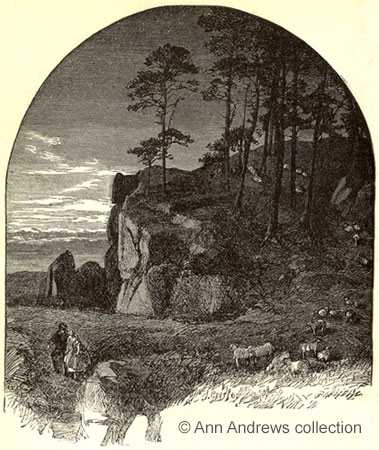 The Black Rocks Scrambling down again, and on to the turnpike leading to Middleton, with a marching accompaniment from a band of birds—the trumpet of thrush, the bassoon of cuckoo, the clarionet of blackbird, the piccolo of robin, and the fife of linnet. The laburnum hangs out its banners on the outer walls of a roadside cottage, and there is an intoxicating sweetness from the purple lilacs. Middleton is one long, narrow, straggling, sordid street, climbing up the shoulder of a hill so steep that the wonder is the houses do not push each other down. One or two pretty houses, flanked and fronted with garden gleams of colour, only serve to lend additional meagreness to the little struggling shops and hovels. The hamlet might have been borrowed from Bulgaria, or to might illustrate Goldsmith's Deserted Village. Some of the houses turn their backs on you. Others are in ruins. The thick stone walls are crumbling into decay. The rafters are grass grown and desolate. The decline of lead-mining has made the village a vulgar Baalbec. The tumble-down tenements are so many melancholy Hic jacets of a departed industry. But Middleton (whose name, by the way, is shared by a much prettier village in the High- Peak) gives access to the Via Gellia,[1] one of the sweetest of the Derbyshire valleys. Deep down winds the secluded valley between steep mountain walls of living green, inclined planes of trees, broken here and there by the gray scarp of a ragged lime- stone crag, The ambuscade on either hand, alive with the trilling intercourse of birds, and fragrant with perfumes that a Rimmel could never extract, is a study of foliage. On the lower waves of the billowy sea of green a thicket of dense undergrowth, wild-briers, woodbines, hollies, and hazel and blackberry bushes that in the autumn time will make the Via Gellia a forest of fruit. Over this tangle the willow, with her flower-catkins, droops her leaves of delicate gray, satin-silvered ever and anon by the stir of the wind. Above is the luminous leafage of branching limes and the stout foliage of alders and chestnuts, Higher still, the silvery birch, "the lady of the woods," waves her winsome tresses, and the mountain-ash disputes a place with the larches and sycamores and maples and the young oaks that are being strangled in their upward growth by the tendrils of the picturesque but paralysing ivy ; while right above the bright broad boles of these trees the dark spires of the sombre fir and the storm-stained pine spines stand out erect on the windy edge of the summit in a solitude of their own, a chevaux de frise against the sky. The roadside is starred with primroses. Lilies-of-the-valley are as common here as the buttercups in May meadows. The blue eyes of the forget-me-not, heavy with tears, peep from the bank-side The bluebell and harebell are eloquent of floral campanology. The pale wood anemone up in a "fern paradise," adder's-tongue, hart's tongue, and maiden-hair sleepwort, of gray moss and silver lichen ; the coy violet betrays her presence in scent. There is no place in Derbyshire where a better bouquet of wild-flowers can be obtained than among the labyrinthine leafage of the Via Gellia Valley. They are sweet, old-fashioned simple flowers that stirred the hearts of the great poets into song. Scientific florists would, perhaps, despise them and landscape gardeners laugh them into scorn, but was it not the meanest flower that blowed that filled Wordsworth with thoughts that lay too deep for tears? A clattering little stream runs alongside the road. Presently comes a Gothic cottage, and at its side Dunsley Waterfall, leaping a white ribbon of spun-glass from the hill-top, and lighting the trees above it under all their leaves, shouts with joy as it tumbles down the rocks to be welcomed by the laughing little rivulet, which has changed its course from our left hand to our right, momentarily ceasing is song to pass under the road unobserved. A felled tree in the glade by the water-margin begs us to be seated. Our satchel is opened. There is an epicurean flavour about our sandwiches for which an Apicus or a Lucullus might have craved. "Hunger-sauces" makes them appetising. The fresh elastic air is a sort of ethereal champagne. Our table-cloth of green is adored with Nature's epergnes of wild flowers, and a choir of feathered choristers are singing while we eat. The odour from our pipes now mixes with the resinous scent of the trees. The only sound is that of birds and brook. Such experiences as these are the renewals of life. They are payments into the Bank of Health, leaving a balance in hand to meet the claims of Sickness when he steps in for his dividends. The country is the true physician, When Hercules could lift Antæus from the fields he was too strong fer the giant; but when Antæeus again touched the green earth, he was inspired with new vigour, and at once overcame his foe. The fields and woodlands freshen us for the fight against Hercules, as they did the mythical Antæus, son of Poseidon, who personified the regenerative power of water. Sauntering down the valley again, There are dark gaps in the universal green that excite curiosity, They turn out to be ancient lead workings. The adventurous "Kalmat" pilots the path into the cavernous gloom of one of these vaults. We light a newspaper torch, and stumble over the stones underfoot, Ugh ! the water breaks from the cold walls on our left, and there is a channel of water on our right. The damp mine winds in us rocky course for a hundred yards or more, There is an unearthly sound of weird water rumbling into unknown depths in front. The newspaper flambeau is giving out, and we see the wet walls and each other's face in a spectral, shuddering, Rembrandt light. Suppose we should stumble on the victim of some secret murder in this deserted cave? Suppose "Kalmat" positively proposes to ignite some letters he has found in his pocket ; but I give ominous hints of "fire damp" and "choke-damp." It is damp enough anyway, and so we turn back to the opening, which has diminished into the size of a threepenny-piece, and I inwardly resolve to introduce the scene in a bloodcurdling chapter of my ghastly romance, the Lost Lead Miner : a Secret of the Hills. (A fern-gatherer from Wirksworth was, by the way, lost in one of these lead-workings, and his absence for some weeks made a sensational paragraph in the newspaper.) The glad light again, with the sprightly stream rambling through a bed of furze and fern and foxgloves and flowers, until it is directed into a sort of continuous wooden trough, green with lichen and clinging weeds; but the glancing water despises the restraint, and wanders out of the artificial channel into mossy windings of its own. Half a mile of this wild beauty, and then comes a cluster of cottages, colour works, lime-kilns, and cupola furnaces. The trees wear a dimmer green. The birds are less blithe. The water of the rivulet is reddened, like a little Alma, as if with blood ; but a little further on in its progress it becomes pure and pellucid again, like a soul that has been washed from sin, and forms itself into linked reservoirs, fed by tributary streams that trickle down the hillside. There is an old weedy water-wheel by the roadside in an artist's setting of scenery, and presently comes what was once the sign of the "Pig of Lead," but is now called "The Via Gellia Inn," a hostelry that reminds us that we have reached Bonsall. Shall we pursue the rivulet to the cotton-mill romance of Cromford, and the comfortable tea at "The Greyhound," or desert it for the beauties of Bonsall? The difficulty of decision is a great one. Both paths have particular charms. We are in the position of the classic donkey, which perished between two bundles of equally dainty hay because it was such an ass as to be unable to determine which was the more toothsome ; of De Quincey, who, having six hours to spend in London when passing through, spent them on the steps of the hotel vainly endeavouring to decide what to go and see; of the typical Englishman of the time in the old cartoon, who stands naked amid a great pile of garments, embarassed as to what clothes he should wear. "Kalimat" solves the problem by a vulgar expedient—heads, Bonsall; tails, Cromford. It is heads. A primitive little village, this Bonsall, with a hundred and fifty marble bridges. So the local joke puts it; for the rivulet, a shallow streamlet of quivering clearness, which runs down the side of the street, is crossed at the cottage doors by blocks of Derbyshire marble. Bonsall once boasted a market, and a prim market cross climbs up from a basement of ten or a dozen steps to proudly assert the fact. But the most picturesque object in this old-world village is the venerable church, which stands upon a rocky elevation and gives its benediction over the heads of the houses that are kneeling beneath. The landscape from this tranquil church-yard on the steep shoulder of the hill, with the westering sun throwing up his last lances of light from the Wirksworth hills, and the valley lying in a shining stillness is one of the most pleasing visions of the day. Through the churchyard where the trees are tapping, tapping at the windows of the old church: past the grand old yew, gloomy with age, for it has braved the storms and basked in the sunshine of centuries: and over the hills in the sunset light to Matlock, which bursts abruptly upon us below—a coup de theatre of wooded hill, jutting crag, bright river, and scattered houses all steeped in the last glow of day. Down the steep side of Masson, over somebody’s fences, to a late dinner at the Devonshire. A balcony at the hotel overhangs the Derwent, whose bosom is now jewelled with a trembling star. We are sitting outside in the twilight, with coffee and a cigars, facing the old rook-haunted elms of the Lovers Walks, with the river murmuring down below, and the evening breeze bringing the musical roar of the weir up the stream. It would be pleasant to linger; but the warm glow has died out of the sky, a mist is rising from the water, the wooded banks opposite are becoming black and shadowy, It is, moreover, train-time. So we leave for the station, carrying away with us choice vignettes photographed on the brain ; so many pleasant dreams to be recalled when we are confronted by the crushing realities of life; poems to be read amid drear pages of prose ; summer sunshine to be borrowed on dark wintry days with louring skies, brutal winds, and blinding fogs; green oases in the sandy Sahara of existence to cheer "our uneasy steps over the burning marl." * * * * * * * I am emptying the inkstand again, It is autumn now. The post brings me a letter from "Kalmat." He says "I own with humility that I have been scandalously neglectful, of the charms of my own country ; for England, I am finding out, is the most beautiful place in the world. That Derbyshire of yours is a pocket-edition of Switzerland, a microcosm of all that is romantic in Nature. I can only pay penance for my past neglect by making another Pilgrimage to the Peak."  [1] Bradbury noted that "The name Via Gellia is a compliment to the late Mr. Philip Gell, of Hopton. At his expense the road through the romantic valley was formed." |
||||||||||
|
*Transcribed by Ann Andrews in November 2025 from her personal copy of the book. Bradbury, Edward (1884) "All about Derbyshire." With sixty illustrations by W. H. J. Boot, J. S. Gresley, W. C. Keene, L. L. Jewitt, G. Bailey, J. A. Warwick, R. Keene, and others. Simpkin Marshall, London : Richard Keene, All Saints', Derby. Images © Copyright Ann Andrews collection. Intended for personal use only. |
||||||||||
The following, also on this website, may be of interest:  Books
and other publicationsImages
- of the MatlocksDerbyshire Picture Gallery Books
and other publicationsImages
- of the MatlocksDerbyshire Picture Gallery |