Here are two postcards of the State Rooms at Chatsworth House. They were part of a series of cards published
by the Midland Railway shortly after the beginning of the twentieth century and were designed to increase
the use of the railway network by tourists.
Chatsworth's State apartments were used by a reigning monarch for the first time in "a great number
of years" when King George V and Queen Mary visited Derbyshire in late 1913[1]. Although King
Edward VII and Queen Alexandra, George V's parents, had been guests of the Duke and Duchess of Devonshire
they were still the Prince and Princes of Wales in January 1901 as Queen Victoria was still alive[2].
So this was a very significant visit.
The five apartments on the second floor—a dressing room, bedroom, drawing room, dining room and
music room—had undergone considerable renovation and modernisation over the previous twelve months
and were described as magnificent. They had been regarded as the principal features of the house for a
long time and had been shown to the thousands of visitors who visited Chatsworth each year[1].
More accolades came in 1936 when H. P. Channon wrote that "it is impossible to exaggerate the
magnificence of the throne room, with its wonderfully carved and painted ceiling. The tapestry room, with
its gorgeous ceiling and walls, the violin room with its carved furniture and walls, together with the panelled
smoking room with its spiral pillars, are but a few of the apartments of Chatsworth which are unique in
conception[3]".
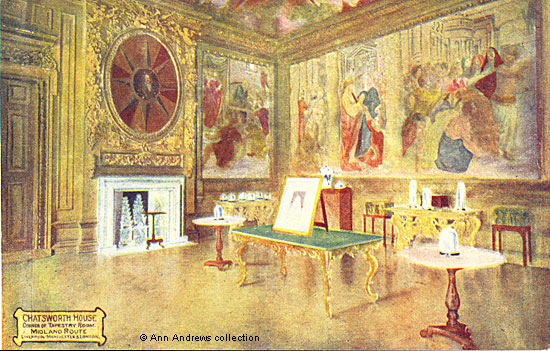
The "Tapestry Room", above, is also known as Chatsworth's State Drawing Room. There are Mortlake
tapestries from cartoons by Raphael that were woven about 1635, covering the walls. A portrait of the first
Duke of Devonshire is above the fireplace and in the fireplace itself are Delft pyramid vases. The green
table, assuming the colour is correct, had a green malacite top and bronze legs.
In 1939, at the beginning of World War 2, Penrhos School in North Wales was requisitioned by the Ministry of Food.
The pupils and staff moved into Chatsworth whilst the moveable contents had to be stored elsewhere. Edward Halliday,
an artist, painted the state drawing room with (up to 20) beds tightly packed in. His painting shows small
mirrored wardrobes in front of the fireplace and the tapestries still on the wall[4].
The State Drawing Room.
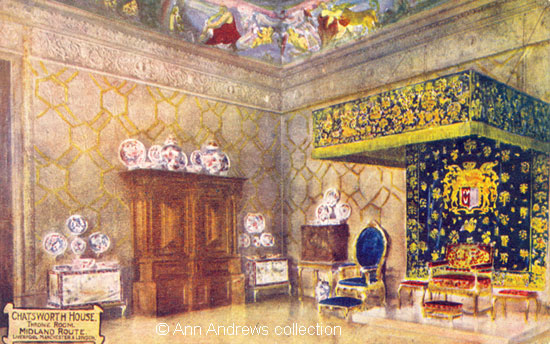
A side strip on the card's address side reads:
"Chatsworth House, Throne Room.—An air of grandeur and solemnity pervades this magnificent chamber.
Its greatest treasures and chief objects of interest are the identical chairs and footstools used at
the coronation of George III. and Queen Charlotte in 1760. Here, too, the ceiling is beautifully adorned with
paintings of classic subjects that cannot fail to charm the visitor."
The coronation chairs and footstools are said to be in the style of Chippendale. They had come to Chatsworth as
"the perquisites of the fourth Duke of Devonshire, being at the time Lord Chamberlain of His Majesty's
Household ; and the splendid gilt chairs which came in like manner by right of office, to his grace the present
Duke, in which his late Majesty and Queen Adelaide were crowned[5]."
Pevsner records that the State Dining Room was never a used as a dining room, presumably because of
the distance from the kitchens. Its original name was the Great Chamber[6].
|



 Derbyshire's
Parishes, 1811, Parishes C
Derbyshire's
Parishes, 1811, Parishes C


