| |
| Bakewell Parish Church - the Ancient Stone Cross |
|
|
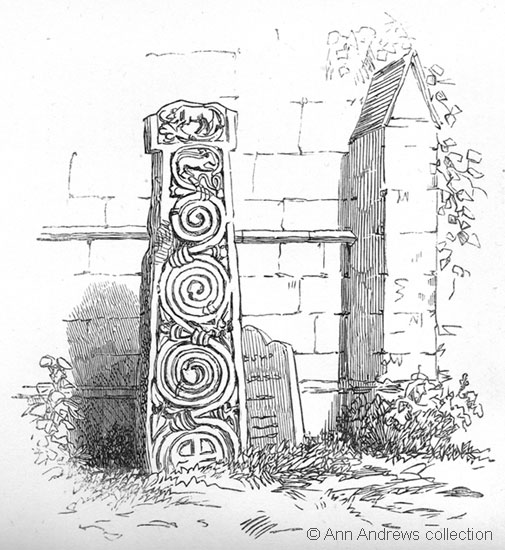
Above is Orlando Jewitt's engraving of the "back" of the cross, facing the church wall, which
was published in Stephen Glover's "Derbyshire" of 1833[2].
It stands outside the east end of the Vernon Chapel and railings surround it today. Several nineteenth
century writers stated the cross was moved to the churchyard but none indicate where it came from
originally. They also only mention one cross at Bakewell. There is second cross in the Bakewell church
yard today, which was presumably moved to the churchyard in the twentieth century.
There were several early engravings or etchings of Bakewell's cross that pre-date Jewitt's, including
those drawn by Bray in 1778 and the ones published by the Lysons in 1817[1].
Glover described this cross as being eight feet high, excluding the pedestal, and two feet wide.
"The ornaments and sculptured devices on the four sides are much worn and defaced, but they are
evidently subjects taken from the scriptures. On this side of the cross are the birth, crucifixion,
the entombment, the resurrection and ascension; on the reverse is Christ entering Jerusalem upon
an ass. These figures are indistinct, and antiquarians have differed in their interpretation of
them"[2].
Whilst it is not know when the damage to the top of the cross occurred, the head had gone and
the arms were damaged before the end of eighteenth century. This was briefly
mentioned in The Gentleman's Magazine in 1794[3] and
Peter Davies wrote about the damage in 1811[4].
Richard Ward, in 1814, thought the cross remarkable but he
found the sculptured figures on the sides almost completely
effaced, noting that "there is another similar to this,
but superior in form and sculpture, in the church-yard at Eyam"[5].
Ten years later Ebenezer Rhodes commented that although Bray,
who had toured the county in the 1770s[6],
had produced three etchings of the cross, he hadn't "regarded
either its origin or history of sufficient consequence to
engage his attention"[7].

Bailey's drawing for J. C. Cox (1877) [8].
Both this image and the stereogram lower down the page shows us a side of the
cross and at the top is includes "Christ entering Jerusalem upon an ass" noted by
Glover [2].
Charles Cox, a nineteenth century church historian, compared the Bakewell cross with those at Eyam,
Hope and Taddington and mentions another of early design at Blackwell, with fragments of similar design
found at Bradbourne, Hognaston and Darley[8]. The Lysons had
thought the cross was Saxon in style and Cox also believed all the Derbyshire crosses, with the exception
of the one at Taddington which is earlier, were Anglo-Saxon —with the Bakewell Cross probably dating
from the eighth century and the Eyam cross possibly a century later.
Bakewell Cross by Alfred Rimmer published as part of a book review in " The Reliquary",
1875-76 [9].
Alfred Rimmer's book about crosses included all types of cross, ranging from market and churchyard crosses
to village preaching crosses. The crosses of Eyam and Bakewell, both of which were in good repair,
were included. "Bakewell Cross stongly resembles Eyam, but the scroll work is not so
graceful, it is also in the churchyard, and is much more ancient than the church, though the latter
contains some fine Norman work. The town of Bakewell is delightfully situated between Matlock and Buxton,
and its other attractions overshadow the cross[9]."
Nineteenth Century Stereograph of the Cross, no date.
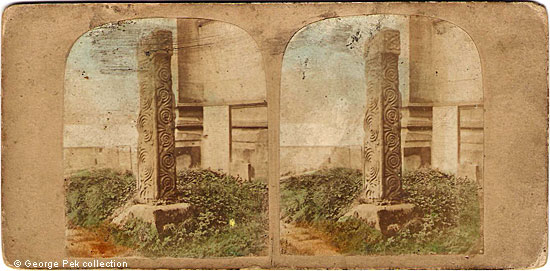
Above is an early hand tinted Derbyshire stereograph of the beautiful
ancient cross in the churchyard at Bakewell. Whilst there is a paper label
on the back, shown below, there is no blindstamp to indicate a publisher. As this
was No.31 in the photographer's series of pictures it must
be of early date, perhaps taken circa mid to late 1850's[10].
The angle the stereo was taken from shows us the scrolls on
two sides of the cross.

As the label shows, the cross was sometimes described as a Runic
Cross
but this is a misnomer as there are no runes on it [8].
|
1. O. Jewitt's engraving from Glover's "Derbyshire" provided by and © Ann Andrews.
2. Bakewell Cross, drawn by Mr. Bailey, facsimiled by Messrs. Bemrose's Anastatic process for Cox's
"Churches" provided by and © Ann Andrews.
3. Bakewell Cross by Alfred Rimmer, from a book review in "The Reliquary", 1875-76[9].
4. Stereograph of the "Runic Cross, Bakewell" provided by and © George Pek.
Written, researched by and © Ann Andrews.
Intended for personal use only.
|
References:
[1] Lysons, Rev Daniel and
Samuel Lysons Esq. (1817) "Topographical and
Historical Account of Derbyshire" London:
Printed for T. Cadell, Strand; and G. and A. Greenland, Poultry.
[2] Glover, Stephen (1833) "The
History and Gazetteer of the County of Derby ..." Edited
by T. Noble. pub. Derby and London.
[3] Read the Bakewell entry
in the on site transcripts of The
Gentleman's Magazine.
[4] Davies, David Peter (1811) "History of Derbyshire" pub.
S. Mason, Belper. Davies seemed to think that the cross was about tenth century ("almost eight hundred
years old"). There is more about the cross in the on site transcripts
of Derbyshire's Parishes, 1811, (see Bakewell).
[5] Ward, Reverend Richard
(1814) "The Matlock, Buxton and Castleton Guide,
containing concise accounts of these and other remarkable
places ... in the ... County of Derby", Derby
[6] Bray, William (1778) "Sketch
of a Tour into Derbyshire and Yorkshire".
A second edition was published in 1783.
[7] Rhodes, Ebenezer (1824) "Peak
Scenery" pub. London, Longman, Hurst, Rees,
Orme, Brown, and Green, Paternoster Row.
[8] Cox, J Charles (1877) "Notes
on the Churches of Derbyshire, Vol II, The Hundreds
of High Peak and Wirksworth", Chesterfield:
Palmer and Edmunds, London: Bemrose and Sons, 10
Paternoster Buildings; and Derby. Cox did not like
the cross being described as Runic and quite firmly
pointed out that the cross could not be "runic" as
a rune is a letter of the alphabet and runic means
marked with runes (i.e. poetry, etc.).
[9] "The Reliquary, Quarterly Journal and Review Vol.
16". (1875-6) Ed. Llewellynn Jewitt, F.S.A. Published London: Bemrose & Son, 10 Paternoster
Row ; and John Russell Smith, 36 Soho Square Derby : Bemrose & Sons, Irongate. Extract from a review of
"Ancient Stone Crosses of England", 99.176-8, printed and issued by Virtue and Co., Ivy Lane
(1875).
[10] Estimated date, but image compared with others in the owner's collection.
Bakewell is mentioned in the following on-site transcripts:
 |
 Derbyshire's Parishes, 1811, Parishes B, which has more about
the town. Derbyshire's Parishes, 1811, Parishes B, which has more about
the town.
The Gentleman's Magazine Library, 1731-1868 (Bakewell
- Buxton), which describes the tombs.
Kelly's Directory 1891: Bakewell, Derbyshire (Part 1) -
history, churches, schools, councils, etc.
Kelly's Directory 1891: Bakewell, Derbyshire (Part 2) -
private residents and commercial |
 |
The Wolley Manuscripts, Derbyshire:
Charters, Documents & Deeds : Places A - B, mentions Bakewell
Pedigrees, Documents & Deeds : Surnames M - P refers T - Z has
Vernon references. |
Elsewhere on the Internet:
Rosemary Lockie provides two modern photographs on Wishful Thinking.
Saxon Cross, now surrounded by railings.
Saxon Cross, Bakewell (Detail of the ancient cross)
Decoding
the Bakewell Crosses - a joint project to understand
and interpret the sculpture
The
Megalithic Portal |
|
|


