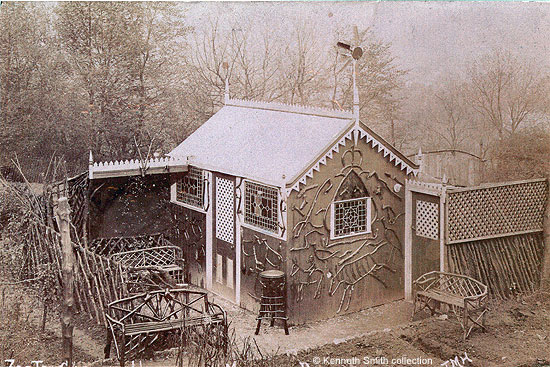
This wonderful but slightly eccentric building, possibly the
ultimate curiosity in garden shed design, used to be in Upper
Wood near the Sports Field[1].
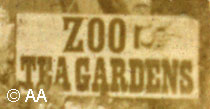
Thirsty walkers or cavern visitors were served tea and refreshments
at the Zoo Tea Gardens which were run by Isaac and
Mary Shaw; Isaac was an Engineer and Boiler Maker[2],
so presumably it was Mary who did most of the work[3].
The Heights
of Jacob Fluor Spar Cavern was some 200 metres down the
hillside, although it had its own tea area.
The Zoo Tea Gardens would probably have served visitors to
the Cricket Ground and the Cumberland and Speedwell Caverns
which were also nearby.
The wooden building is decorated with interpretations of wild
birds and animals. On the side adjacent to the stool, for instance,
is a man on a horse who is smoking a pipe and the horse is
being chased by a reindeer. There is a crown just below the
apex of the roof and snakes, more animals
and another pipe smoker are on either side of the fretwork
window[4].
Similar designs surround the doorway and the other two windows.
To the side is a rustic sunshade which is decorated in similar
style with a reindeer head and antlers; it is rather small
for the real thing but could be, otherwise it is purely decorative
and probably carved from wood.
It is likely that the rustic garden seating provided for the
customers was made from the many trees and saplings in the
vicinity, possibly by William Widdowson who was a jobbing gardener
in 1901 and would have had the skills to make it[3].
Willow, birch, or alder saplings are all suitable for this
type of furniture[5].
However, it was probably created by Isaac Shaw to
amuse his young daughters, whoever made the furniture.
It is even possible that the windmill on the top served as
a wind generator.

Zoo Tea Gardens, Upperwood
The second postcard shows the Shaw family outside the front door
of their Upperwood home. More rustic furniture is featured,
including large plant pot stands in the same style as the seats.
The crates, bottom right, probably contained water bottles
but could equally have been full of ginger beer or soda water
which was made locally.
Isaac, who was considerably older than his wife, was christened
at Sutton cum Duckmanton on 19 Jul 1840[6].
He had been married before and his first wife was Emma Haywood,
whom he married at the Independent Salem Chapel in Wingerworth
in 1863. By 1871 the Shaws were in Brampton with their eldest
daughter Elizabeth Ann[7].
Rosa followed in 1878[8].
In 1890 Isaac Shaw and Samuel Fidler of Chester Street, Brampton
applied for a patent for "Improvements in miners' picks,
axes, hammers, and other similar articles and in the mode of
securing the same to the shaft"[9].
We learn for a court case in the early 1890s, after
Emma was verbally abused by a local man, that Isaac also owned
properties in Brampton.
Emma died on 3 June 1893[10]. Isaac
continued in partnership with his two daughters and eventually
Elizabeth's husband Charles Etchells until 1898 when he
retired[11]. They
traded as Shaw and Co., ironfounders and stove and grate manufacturers
and salesmen.
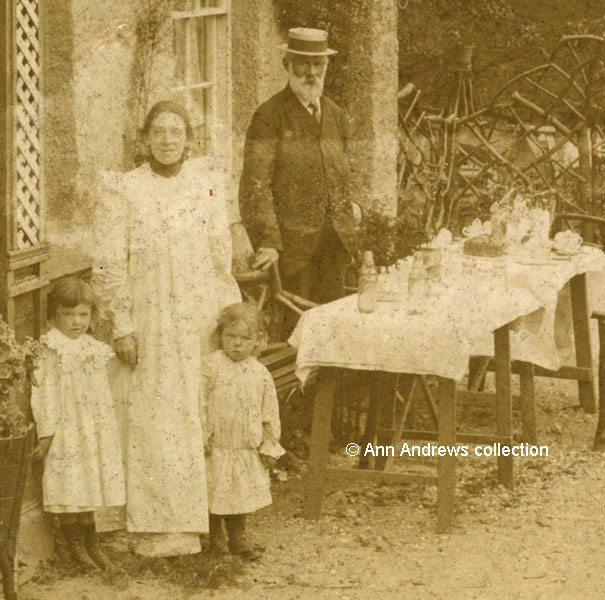
This enlargement of the image above shows, from left to
right, Harriet Shaw (born 1904),
her mother Mary, sister Nelly (born 1907) and father Isaac.
The trestle tables are laid for tea, with a large fruit cake waiting to be eaten.
Mary Rowbotham became Isaac's second wife, marrying him
at St. Helen's Darley Dale on 13 Feb 1904, and Harriet was
born later that year. Presumably both girls were educated at
Matlock Bath School. Nelly is definitely remembered attending
the school[3].
The Shaw family were well settled into village life by 1907: "Messrs
James Boden and Isaac Shaw combined resources for the Venetian
Fete land competition and won maximum points for their Adam
Bede's Cottage"[13].
It is not known when the family left Matlock Bath but
Isaac died at Chesterfield, aged 90, on 21 April 1931[14].
He was buried at St. Thomas's Church, Old Brampton, with his
first wife and their son William Thomas who died as a child.
|