|
Images Index> Matlock Bath, 20th and 21st Century Images> This page |


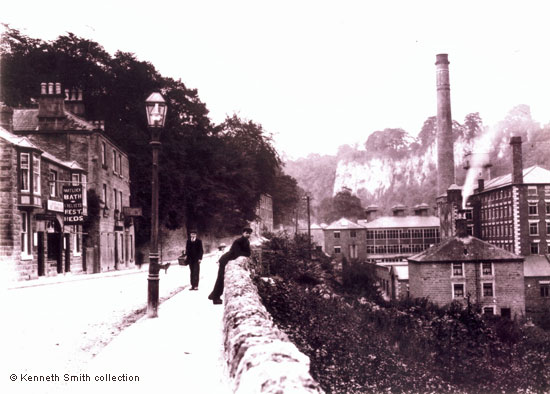
| Matlock Bath: The Rutland Arms & Masson Mill |
| Matlock Bath : Twentieth Century Photographs, Postcards, Engravings & Etchings |
|
|||
This photograph is probably the slightly later of the two as some of the shrubbery is fractionally bigger. The words on the banner displayed outside Boston House differ slightly from those on the previous image, too: Matlock Bath | Cyclists | Rest | Beds. Cycling had become popular and cycle groups used to visit Matlock Bath every weekend. Boston House had been for sale in 1898 following the death its owner, the papermaker James Sheppard, who had run the paper mill next to Masson Mill. Boston House was subsequently tenanted by Mr. J. W. Boden who afterwards went to the Ferry House[1]. The identity of the two boys and the young girl wearing a boater hat is not known; they might be locals or, equally, they could be trippers from Derby or Nottingham. On the opposite side of the wall was the under manager's garden[2]. There are three things that help date this picture, two of which were mentioned by Benjamin Bryan in 1903. He wrote that, following the transfer to the English Sewing Cotton Company in 1897, "a factory chimney of red brick has since been erected, and the high wall which screened the mill from the road pulled down[3]", though he did not provide a date. The chimney was built in 1900, as were the newer brick buildings on the mill site. So this photograph shows the mill in the first decade of the twentieth century, before further major construction took place at Masson Mill. In 1910 this mill had been described as a picturesque factory and was said to have been "practically identical with that erected by Sir Richard Arkwright in 1784"[2]. But it had already been altered and there was to be a large extension, built in 1911, when a somewhat harsher Accrington red brick was used in the construction. There is a photographic postcard of the 1911 extension on Arkwright & his Cotton Mill in Matlock Bath, which changed things considerably. William Adam had described what the visitor saw in 1838 when entering the Dale from the southern end and wrote of the Mill "instantly" appearing on the right[4]. It was not just the visual impact of Masson Mill that had made an impression on Adam. "The clatter of its thousand spindles and tinckling of its bells, warning the attendant its hank, or proper quantity is completed, instantly strike upon the ear".
|
|||
Photograph of Masson Mill, ca. 1911-12, in the collection of and provided by and © Ken Smith. Image scanned for this website and information written, researched by and © Ann Andrews. Intended for personal use only. |
|||
|
[1] "Derbyshire Times", 24 September 1898. Property Sale at Matlock Bath. The lot was withdrawn from sale. [2] "Derbyshire Advertiser and Journal" 2 July 1910. The under manager was Reuben Gregory. [3] Bryan, Benjamin (1903) "History of Matlock - Matlock, Manor and Parish" London by Bemrose & Sons, Limited. [4] Adam, W. (1838) "The Gem of the Peak;
or Matlock Bath and Its Vicinity. ..." London; Longman & Co.,
Paternoster Row ; ... Mawe, Royal Museum, Matlock ; .... This was the first
edition of his guide. |


 Woodbank, 1910


 Dr. Erasmus Darwin wrote several verses
about Masson Mill. See
Dr. Erasmus Darwin wrote several verses
about Masson Mill. See