|
Images Index> Matlock Bath, 20th and 21stC Images> This page |


| Matlock Bath: The Royal Hotel and garden |
| Matlock Bath : Twentieth Century Photographs, Postcards, Engravings & Etchings |
|
|
|||||||||||||
"Royal Hotel, adjoining the New Pavilion. A first-class modern Hotel, in the finest situation, overlooking a grand Panoramic Scene. Five acres of pleasure grounds, fountains, tepid swimming bath, tennis lawns &c. Tariff moderate[1]" In January 1885 the fifth annual ball of the Conservative Association was held at the hotel. Four of the web mistress's Clay great great uncles were listed amongst the guests. "The ballroom, under the superintendence of a committee, had been artistically decorated for the occasion, the walls being adorned with oil paintings, evergreen, &c. The spacious hall and the conservatory were reserved for a promenade of the daughters and great pains had been bestowed to secure comfort for the company. ... nearly 100 ladies and gentlemen were present. Supper was partaken of at midnight[2]". The Royal Hotel had already earned a reputation for being top class. 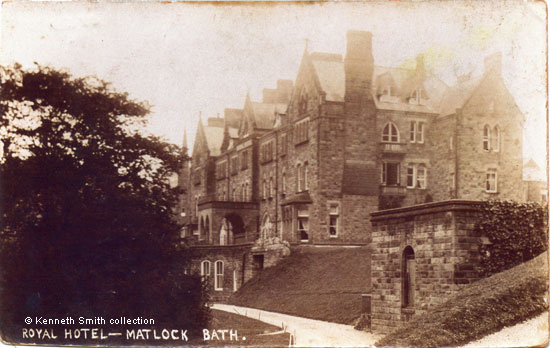 This sepia card was taken at a similar time to the top image and provides us with a closer view of the front of the hotel. The small pool building on the right survived for years after the original part of hotel was demolished.
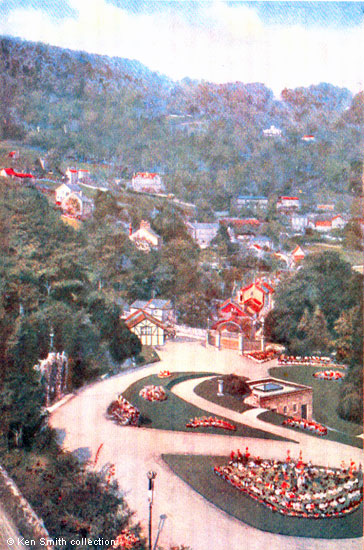
The grounds were beautifully kept. There was a large vegetable garden and the hotel also had extensive summer gardens with a large rose collection that was greatly admired by the visitors[4]. There was also a revolving summer house in the grounds.
The Army used the land during the Second World War and they left behind the footings for their buildings, which were an eyesore in the village for quite a long time despite being a great play area for the children. And a probably forbidden one by their parents. This garden is now covered by the tarmac of a public car park. The car park was a necessity for visitors to use, as there was very little elsewhere, and has provided some relief for the village's narrow roads. Not shown above, but to the right and lower down closer to the road, is the pond with a large tufa stone in the middle where, in the 1950s and undoubtedly before then, the local children used to fish for tadpoles and look for newts and other pond life. The pond used water from the swimming pool; it then went to the petrifying well under Temple Walk and finally across the road to both the paddling pool and some went into the fish pond. There is a later picture of the Royal Hotel taken from almost the same position which shows a large extension at the back of the building and other additions. 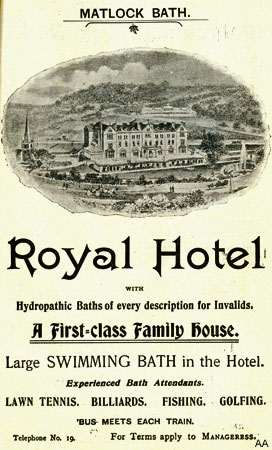 1903 Advertisement for the Royal Hotel, when Mrs. Shaw was the Manageress |
||||||||||||||
|
Images: 1. Postcard of the "Royal Hotel, Matlock Bath" published by Valentine's Series, No.17497. Published in Great Britain and first registered in 1892. Posted 24 Aug 1910 at Selston, Nottingham. sent to Mrs. Jacques, Attercliffe, Sheffield but message not relevant to image. Postcard in the collection of and provided by and © Pauline Jordan. 2. Postcard of the "Royal Hotel, Matlock Bath". Publisher unknown. In the collection of, provided by and © Ken Smith 3. The grounds of the Royal Hotel. In the collection of, provided by and © Ken Smith. Another postcard of the same scene was posted in 1927. 4. Advertisement for the hotel from "Abel Heywood's Guide Books, With Cycling, Walking and Driving Routes. Matlock Illustrated." (1903) Abel Heywood & Son, Manchester & London. In the collection of, provided by and © Ann Andrews Researched and written by and © Ann Andrews. Intended for personal use only. |
||||||||||||||
|
[1] Advertisement in the "Daily News", Wednesday, 15 September, 1886. [2] "The Derby Mercury", Wednesday, 7 January, 1885. Conservative Ball at Matlock [3] From Ken Smith, who swam in the pool. [4] Charles Beresford, in "The Bath at War, A Derbyshire Community and the Great War" (2007), mentions some of the rose varieties. [5] See: Percy
Rowbottom, artist and photographer. |