|
Images Index> Matlock Bath, 20th and 21st Century Images> This page |


| Matlock Bath: Jubilee Bridge and the New Bridge, 1960s |
| Matlock Bath : Twentieth Century Photographs, Postcards, Engravings & Etchings |
|
|||
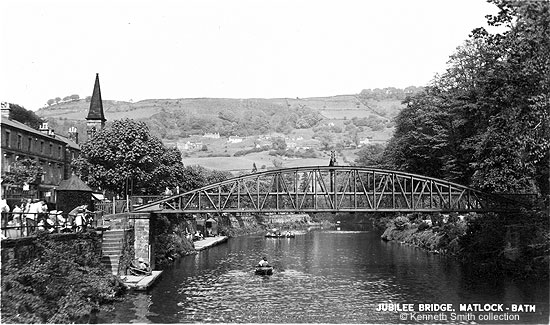
By the time this photograph was taken there had been some minor changes to the two landing stages on the river's edge. For years there had been shelters on both of them, but they had been taken down. On the small landing stage on the far left a small boat is stored out of the water. Rowing boats were for hire from the other landing stage and a small wooden hut was at the far end. There are two rowing boats side by side quite close to the bank about half way upstream. Someone is standing up in one of them. This was perhaps not a wise move, despite the river looking so peaceful, if you consider all the accidents there have been over the years. A "DANGER" sign can be seen strung across the water further up-river, warning those enjoying their Sunday afternoon's boating of the hazards ahead and the board's reflection is sharply defined in the calm water. Few photographs were taken of this side of the bridge. An earlier picture of the south side of the bridge was published some fifty five years or so before thiss one was published. See Jubilee Bridge, River and Promenade, 1890s. In 1955 Matlock Bath's Venetian Fete Committee had decided that something had to be done to relieve congestion on Jubilee Bridge Bridge during the Venetian Fete. The bridge had not been designed to take the weight of so many people standing on it to both watch the fireworks and enjoy the illuminated boats on the river. An additional means of accessing Lovers' Walks was needed. Whilst recognising that it would be costly it was agreed to instruct the Leicester firm of Messrs A. Pole and Sons, who were steeplejacks and bridge builders, to erect a temporary tubular steel bridge over the river. This project was to be at the north end of the promenade and was expected to handle a maximum of 10,000 visitors, though would only be in situ for a short while[1]. In 1962 a Bonsall resident wrote to the Mercury suggesting a better project, especially
regarding the flow of visitors, who would not have to double back on themselves to leave
the Lovers' Walks. Mr. Cordin's proposal was for a new footbridge near the Pavilion
landing stage[2], a suggestion that was
eventually taken up and permission granted to construct it in 1968[3]. 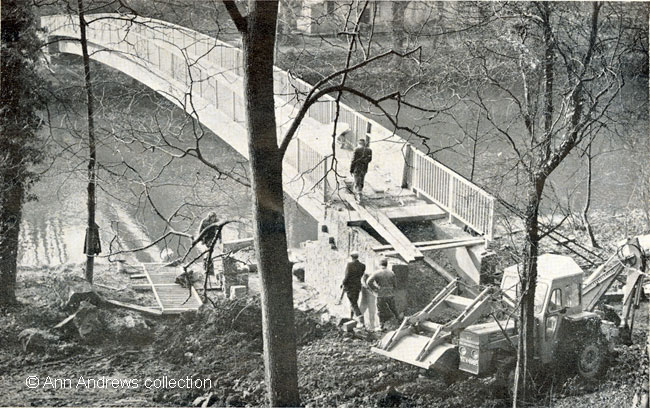 The New Bridge at Matlock Bath (in the course of contruction).
|
|||
1. Postcard, "Jubilee Bridge, Matlock - Bath", in the collection of and provided by and © Ken Smith. This card published by A. W. Bourne, 32 Babingley Drive, Leicester, a real photograph. 2. The New Bridge, from the Illuminations and Venetian Nights programme, 1969 © Ann Andrews collecion. Images scanned for this website and information researched by and © Ann Andrews. Intended for personal use only. |
|||
|
[1] "Belper News" 5 August 1955. New Bridge Should End Congestion. [2] "Matlock Mercury" 21 April 1962. Letters to the Editor. Build a Centenary Bridge. [3] "Matlock Mercury" 4 May 1968. Matlock Urban Council were granted permission by the Ministry and Housing and Local Government. It was to cost £14,350. [4] "Illuminations and Venetian Nights programme", 1969. |