| |
John Smedley designed a range of steam boxes, baths and douches, as well as some other gadgets,
for use at both the hydropathic establishment and the free hospital.
Several were sold at Lea Mills for use in the home.
He believed that the surface of the skin should be kept clean and soap and water were very important so he
designed a number of baths to be used as part of the treatment his patients received alongside plain food and
his insistence that no alcohol should be consumed on the premises.
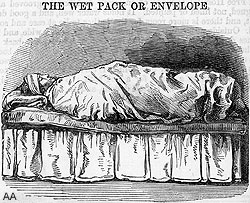
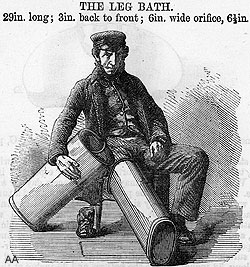
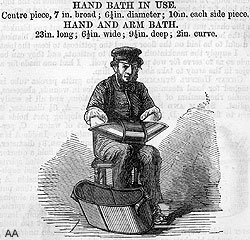
The illustrations and quotations below are taken from John Smedley's "Practical Hydropathy" and
Mrs. Smedley's "Ladies Manual" and show some of the equipment that was used for treating patients.
Steam Box
 |
|
"B is the seat the person sits upon,
then close the door, and put down the lid, the head going
through the hole A, 12 inches in diameter. 4 feet high, 29
inches wide, 34 inches from back to front, outside measure. ...
The steam is sent under the seat ....
This bath is used for five to ten minutes, or in some cases fifteen minutes, and after it a tepid dripping sheet, or
a tepid sponge." |
Sitz Baths

|
|
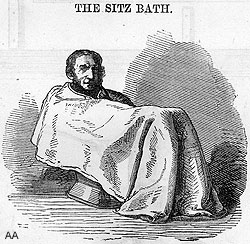
1. Sitting or Sitz Bath
"A common wash tub or any vessel about 12 inches deep, will do."
There is a picture of this sitz bath being used lower down the page. The patient is covered.
There was no children's sitz, despite being mentioned on this image, in either of the Smedley books. |
 |
2. Ladies' Running Sitz
"Double a dry sheet, and lay it over the front of the bath F, and sit upon it, and when rising, draw it
round the legs to dry with.
I have invented this bath, which can be used without any undressing. It should be in every lady's room, and
if used as commonly as the wash hand basin would prevent weakness of the spine, and the long list of distressing
weakening ailments to which all females are liable". |
Douche Baths
 |
|
"There are various modifications of these applications : the principal is the one which, from a cistern,
containing one to two hundred gallons of water, a short tapering pipe contracted to 1¼ inch at the point,
or lower aperture, worked by a lever, allows the water to fall with considerable force from a height of eight
to twelve feet."

"Mr. Smedley's newly-invented ascending douche can be used in bedrooms with perfect safety. ...
For females it is of great importance, and may be used with perfect safety, the action being delicate, and can
be used often without undressing." |
Shallow Bath

"This is a very useful bath ...
The bather lies down in it half filled with water, and rubs quickly the legs, arms and body. ...
One or two gallons of cold water may be poured on the spine before coming out, but it is not quite necessary."
Wood Shallow Bath

It is "made of one inch deal boards, grooved and tongued, not lined or painted. It holds water well, and a good
deal of it, and there is more room for the bather to lie at ease and soap well." Outside measure, 6 feet 5 inches
long, 27 inches wide and 17 inches deep. E is a flat board, 4 inches broad, to lay the back of the head upon, and it
slopes down the bath to support the back. C is a loose cover, merely put on to avoid exposure of the person. A is a
steam or hot water pipe, which is carried round the bottom of the bath unde a board, for a hot bath. B is a
1½ inch pipe brought to 1¼ inches for a back bouche, and to fill the bath. A plug in the corner
lets out the water."
Smaller items
1. Head Bath

"An excellent application for soothing and cooling the head."
F is where the back of the head was to go, with the person
lying on the floor and a pillow under the top of the shoulder. |
|
2. Etna

"For heating cocoa or tea, very useful."
|
3. Steam and Spirit Lamp Bath

"The person undressed, enveloped in blankets, or coverlids,
or mackintosh, sits on a wooden-bottom chair, the steamer
under. If at any time too hot, raise the blanket to let air
in, or to make the spirit burn better. After steaming, sponge
over with cold or tepid water." |
4. The Hydropult.

"The Hydropult, a valuable invention, for Spouting Spine, or Limbs, and any other purposes." |
Fomentation

"First spread a mackintosh on the bed, then two blankets, on which the person,
with only the trunk part of the body undressed, is laid ;
one of the fomenting flannels, previously wrung out with hot water,
is placed under the back, and another over the chest and bowels ;
then bring one side of the blanket over, put the arms down, then lay the hot can on
and put the other sides of the blanket over, then the mackintosh. The person lies quietly from
three quarters to one hour, and will often go to sleep. Afterwards wipe the trunk with a towel
wrung out in cold water, and dress, or have a dripping sheet, or cold or tepid wash over."
Baths
|


John Smedley


Caroline Smedley
|


 Advertisement
from "On Foot Through the Peak", (1868)
Advertisement
from "On Foot Through the Peak", (1868)