|
Images Index> 18th & 19th Century Images> This page |


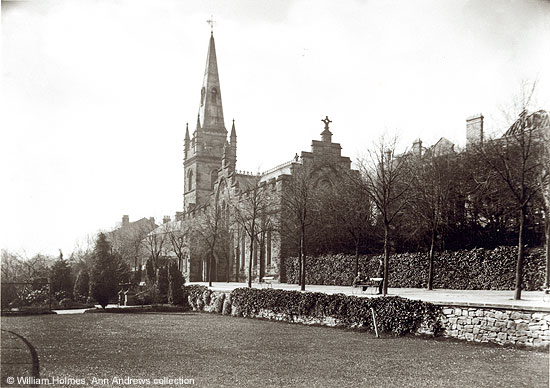
| United Methodist Free Chapel, Smedley's Hydro, Matlock, 1885 |
| Eighteenth and Nineteenth Century : Photographs, Postcards, Engravings & Etchings |
|
|||
John Smedley erected this large chapel in 1870; it was one of several churches he had built. Just before it was completed one of the local papers commented that it "will form a prominent feature in the surrounding scenery"[1]. Following his illness in the late 1840s Smedley had become very bitter regarding the Established church, but before that he had equally as intolerant of the Dissenters. "So when John Smedley found that the Established Church was indifferent to his well-meant suggestions [amongst other things he re-wrote the Prayer book], he turned to a church which was more accommodating. The Free Churches, as they were called, had not unalterable canons of tradition to hamper the free play of the spirit"[2]. Buckley, writing in 1888, said that Smedley's "monuments of practical Christianity" could "still be seen at Holloway (near his works), Bonsall, Higham, Matlock, Birchwood, Ashover and other places", erected at a total cost of £5-10,000[3]. Some, but not all, of the buildings are still standing today. The chapel is drawn on the 1876 Ordnance Survey Map and is also shown on Smedley's Hydro Plan of 1875 (next image). Both Kelly's 1876 Directory and the 1881 version mention the "Free" Methodists on Matlock Bank[4]. Whilst it has not been possible to work out who other ministers were, Rev. J. N. G. Faull, who lived on Chesterfield Road[5], was the minister in 1881. He gave "connective readings" at a Service of Song (called "Elijah") at the church[6]. He had served as a Methodist minister since 1848 and had been in the post at Smedley's since moving from Yorkshire in early 1879. Sadly for Smedley, his church at the hydro proved to be a religious white elephant and did not last long as a place of worship. Some years after Smedley's death the chapel was converted to a dynamo house and its worshippers moved to premises on Snitterton Road[7]. Du Garde Peach wrote that in 1888 "electric lighting came to Smedley's, and it is interesting to note that the appreciation of scientific inventions which characterised John Smedley still animated his successors[6]". Benjamin Bryan stated that the engines and dynamos [for a newly enlarged Smedley's in 1901] were "placed in the church erected by Mr. Smedley for the performance of non-sectarian worship according to his own ideas[8]". Arthur Mee[9] described it thus: "the embattled building with a tower and a tall spire facing the church [All Saints'] was a chapel where John Smedley used to preach; now it is an engine-house for running his hydro". It was eventually demolished. The web mistress has a photo of ca. 1955 where at least the spire was still standing but it had gone by the time of a later photograph, taken in 1964 (see: Matlock from Matlock Bank, 1904-06). The United Methodists' final church was on Imperial Road. It is interesting to note that the records for that church began in 1879,[10] when Rev. Faull was the minister for the United Methodists at Smedley's. 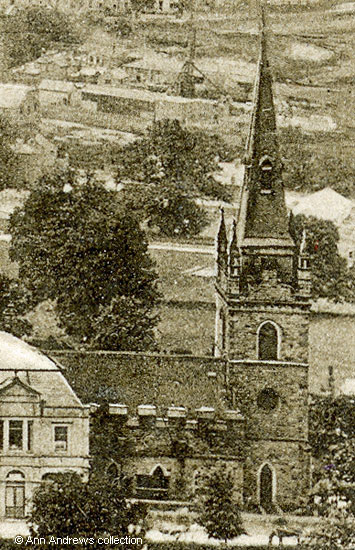 View of the church from higher up Matlock Bank, 1904-6. |
|||
1. Photograph in the collection of, and provided by Ann Andrews. Intended for personal use only and is not to be used for commercial gain. © William Holmes, who owns the original glass negative and bought its copyright. This image has been enhanced as the negative is 120 years old and a is little faded in places. 2. Enlargement of a postcard "Matlock from Matlock Bank". Published by Salisbury Ball, Sheffield, No.10600 B.C. Printed in Germany. Researched, written by and © Ann Andrews. Intended for personal use only. |
|||
|
[1] "Derbyshire Times and Chesterfield Herald", 25 June 1870. [2] Peach, Lawrence du Garde (1954) "John Smedley of Matlock and his Hydro", Bemrose Publicity Co.: Derby & London. Peach is inconsistent with the year electricity was introduced to Smedley's as in one place he says it was installed in 1886 and twice he say the year was 1888. [3] Buckley, J. (1888) "Recollections of the late John Smedley of Matlock and The Water Cure", John Heywood, Manchester and London. Reprinted, with an introduction by David Barton (1973), by G. C. Brittain and Sons, Ripley and re-published by the Arkwright Society, Tawney House Matlock. [4] "Kelly's Directory of Derbyshire" (1876 and 1881), pub. London [5] See Rev. Faull in the 1881 census transcripts. He had served as a Methodist minister in Chorlton Upon Medlock (1871 census) and at various churches in Yorkshire before moving to Matlock. By 1891 his wife had died, he had retired and had moved ton Weston Super Mare to live with his sister. He died at Weston Super Mare on 15 Dec 1906. [6] "Derbyshire Times and Chesterfield Herald", 14 May 1881. Report of the Service of Song. [7] "Derby Daily Telegraph", 17 May 1887 and the "Derbyshire Courier" 21 May 1887 both reported that the United Methodists had moved to the former Wesleyan Chapel on Snitterton road the previous year. [8] Bryan, Benjamin (1903) "History of Matlock - Matlock, Manor and Parish" London by Bemrose & Sons, Limited [9] Mee, Arthur (ed.) (1937) "Derbyshire: The Peak Country", The King's England Series, Hodder and Stoughton Limited, London. [10] With thanks to Rosemary Lockie for
sharing some of her own research. See GUKUTILS:
Derbyshire Places of Worship (John Smedley's Church (Demolished), Matlock) |