| Matlock
Bath: CDV of North Parade, 1870s (3) |
| Eighteenth and Nineteenth Century : Photographs,
Postcards, Engravings & Etchings |
| |
|
|
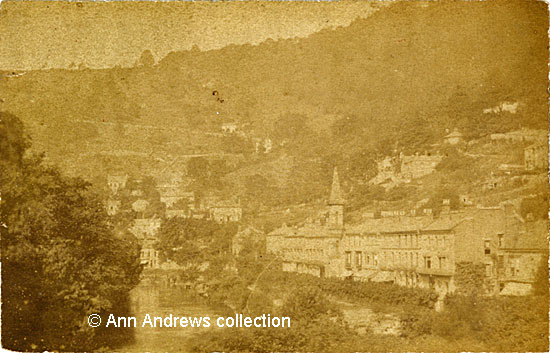
This view of the shops of Derwent Parade, part of North Parade,
shows the newly built Wesleyan Methodist Church and the
lower slopes of the Heights of Abraham and probably dates
from the early 1870s. In the foreground is a narrow strip
of undeveloped ground between the road and the river; it
was to be eventually to become the promenade and was enjoyed
by visitors and locals alike until the 1960s. As already
mentioned on the two previous pages, money to develop the
land had been collected by public subscription in 1873
as a "prom" was said to be something many had
long desired[1].
It was to be 300 yards in length[2].
The 1880 OS map shows a relatively short walkway
running along the edge of the river bank extending from the
former Wesleyan Methodist church to approximately where Valley
Steps are today[3].
It was reported that Matlock Bath had been visited by a
large number of pleasure seekers in early July 1874, despite
odd grumblings about its dusty roads. Although a water cart
was in use each day, the hard limestone of the road surface
dried quite quickly and it was difficult to keep the dust
down but visitors to the Bath were not able to escape it
by walking beside the river. At the time the newspapers reported
optimistically that "It is hoped that the
New Promenade will be opened shortly"[4].
It was said to be "charmingly situated,
and although not extensive, it has been laid out to the best
advantage"[5].
Bryan states it was open and in use in 1874[2] but
for some reason it was not open the following year[6].
Derwent Parade was particularly attractive for businesses
as it was close to the railway station and the shops, several
of which had extensive frontages, would have been the first
port of call for people visiting the village. The proximity
to the station was often mentioned in business advertisements
such as one placed by J. W. Wheatcroft in 1870[7].
Samuel Schofield, Edward Wheatcroft's son in law, was the proprietor
of the George Hotel in 1870 which he described as being just
three minutes from the station. The George, a few doors to
the right of the church, had a "large assembly room, suitable
for firms or schools visiting Matlock" [Bath][8].
|
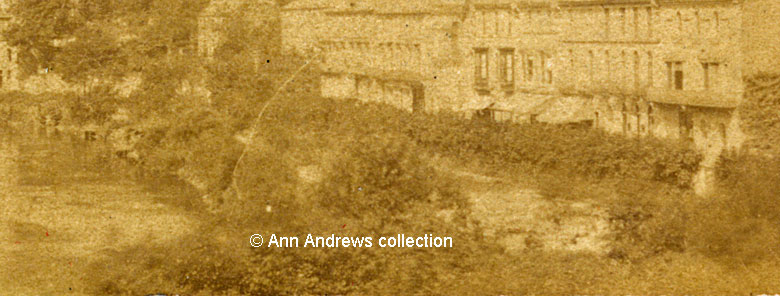
Close up of the river bank in front of the North Parade shops
in the 1870s. The enlargement highlights what a poor state
the land was in. The road was bordered by a long hedge on the
riverbank side.
The George Hotel, mentioned above, is the building with the round topped windows
on the right
- next door to Rockvale House (extreme right). There appear to be boats moored
further along the river.
|
More information about the shops and businesses in Matlock Bath
at the time can be found in the following on site transcripts:
 The
1871 census for Matlock Bath. The
1871 census for Matlock Bath.
Enumeration District 11 covers the properties from Glenorchy to the
former vicarage. Unfortunately full addresses were not recorded.
Kelly's
Directory, 1864 and Kelly's
Directory, 1876. Also provide names, but not necessarily
addresses.
Bemroses'
Guide, about 1869 Advertisement for Joseph Greaves of Derwent
Parade.
There are two stereo views of North
Parade on the Just Images section. See Image
19 and Image 20
|
1 and 2. Both images © Ann Andrews collection.
The CDV is an albumen print mounted on a small card measuring
6.3cm x 10.4cm. Publisher/photographer unknown.
Information researched, written by and © Ann Andrews.
Intended for personal use only.
|
References:
[1] "Derbyshire Times",
Saturday 12 July 1873. The land was said to be 300 yards long.
However, the "Derby Mercury" of 9 July 1873
reported that it was 800 yards in length. Also see: North
Parade, late 1870's (1).
[2] Bryan, Benjamin (1903) "History
of Matlock - Matlock, Manor and Parish" London by
Bemrose & Sons, Limited.
[3] Old OS maps can be found via the Links
page.
[4] "Derbyshire Courier",
4 July 1874.
[5] "Derbyshire Times",
24 June 1874.
[6] "ibid", 21 July
1875.
[7] J. W. Wheatcroft advertised two
commodious and substantially built dwelling houses with shops
attached for rental in the "Derbyshire Times" of
18 June 1870.
[8] "Derbyshire Times" advertisement,
7 May 1870.
|
|
|