|
Guides Index> All About Derbyshire> This page |


| All About Derbyshire by Edward Bradbury, 1884 (6).* |
| Eighteenth and nineteenth century tour guides about Matlock Bath and Matlock |
Railway Readings. Chapter XXIII THROUGH THE PEAK ON THE ENGINE OF THE EXPRESS, pp. 342 - 353 |

|
|||||||||
 Verse at the beginning of the section on Railway Readings: "Is this the power that has transformed the world ? This fainting thing the tenderest grassy blade Can pierce, torn by each bramble in the glade ; Or as it floats in thinnest wreaths uncurled, Caught in the little ashen palms empearled, That chafe and fret it in their babbling shade To nothing ; this that is and is not, swayed Lighter than thistle-down by light airs whirled ; A momentary breath that scarce in May The bedded gold can tarnish by the brook ; That yet bound in by strong necessities Nor at its wayward will left free to stray, The earth beneath its flying thunder shook, And poured behind it streaming vales and skies. ELLICE HOPKINS' "Railway Steam." The chapter begins with: Let no one say that Reality lacks Poetical Interest. GOETHE. |
||||||||||
Pending the approach of that consummated epoch, we can content ourselves with doing Derbyshire in sixty minutes. This is by no means an insignificant achievement of the Annihilation Age. In those "good old days," to whose memory we are so ardently attached, and for whose return we sometimes sentimentally sigh, the journey from Derby to Manchester was a very serious business indeed, and one which included saying farewell to your friends, and making your last will and testament. But in these high-pressure times, these rapid days of telephones, microphones, and electric lights, the express accomplishes the distance in an hour-and-a-half. The Midland Company justly claim for their route that it "passes though the most picturesque portions of the Peak of Derbyshire and the Vale of Matlock ;" but this description tremendously understates the charms of the ride. The windows of the "bogie" carriage, or the Pullman car, form an ever-changing panorama; but the scenery regarded from the footplate of the speeding engine is a railway romance. The courteous kindness of the Chief of the Locomotive Department of the Midland Railway provided me with a place on the engine of the Manchester express, and my only regret is that I had not John Ruskin for company, to have shown him sentiment in steam, romance in realism, fancy in fact, poetry in points and crossings, sermons in sleepers, songs in steel rails, books and signal-boxes, tongues in trenails, and good in all railway things. Here she comes tearing into Derby station this June afternoon, after a three hours' burst from St. Pancras. The snake-like hiss is the action of the Westinghouse brake, The train is pulled up within its own length. Five minutes. The driver, who scrutinizes my credentials, is like Toodles, and necessarily wears a very dirty face, and a butcher’s blouse, blue-black ; and is "besmeared with coal-dust and oil, and has cinders in his whiskers, and a smell of half-slaked ashes all over him." He is also a short, stout man. All engine-drivers are short, stout men. His "mate," the fireman, is a thin, wiry man. All fireman are thin, wiry men. Fat drivers and thin firemen are the rule, and the very moment a fireman is promoted to be a driver he developes [sic] a constitution. "Toodles" is oiling the shining sinews of the Iron Horse with an evil-smelling emulsion from a tin vessel which, like some politicians, runs to "spout ;" while the snorting ardour of the steed of steel is being cooled by some gallons of cold water, which, however, only increases his impatience, and might be some inflammatory liquid, instead of pure "crystal spring." A hasty shutting of carriage doors, the guard’s shrill whistle, a shriek of acknowledgment from be engine, and then a full-throated "fluff-fluff," followed by a faster "chay! chay! chay !" each individual blast coming faster and faster, and faster, until they emerge in a continuous dither. The hard, hot foot-board quivers with motion. One would think that the superior heaviness of the locomotive, the seventy tons of gliding weight, would make it run steady, far more steady than the comparatively light carriages. A mistake, the shaking on the engine, is largely increased. Everything is adamantine and unyielding. Just as a "land-lubber" has to find his "sea-legs" on ship-board, so an embryo engineer riding on an express locomotive has difficulty in keeping his feet, and has to "hold on." To move without support is a difficult operation. I have often in my childish ignorance wondered why enginemen are always eating when they stand at stations. The enigma is solved. It is surely because the engine shakes down their cold lunches, leaving that vacuum which nature abhors. The noise, too, is increased a hundredfold. I make an observation to "Toodles," standing with hand on the regulator, with engrossed eye on the glass disc before him. His lips move in comic pantomimic helplessness in reply, the rushing wind has caught his words, and they are carried off after the telegraph poles, which are chasing each other in an endless race. Before we left Derby the dazzling dog-day heat was oppressive to perspiring-point. A burning pulsation was the only suspicion of air. But now a very whirlwind is rushing past, and if it were not for the gridiron which is frying my feet to a turn, the sensation of riding on the engine would be one of cucumbrian coolness. A healthy and long life is supposed to be ensured by keeping the feet warm and the head cool, and enginemen should live to become centenarians, since they always observe these medical conditions. But while I have been relating these experiences, Darley Church has looked down upon us from its wooded knoll by the river; the knob of moorland from Little Eaton, and the coloured hillside at Duffield Bank, with its houses smothered in trees, are passed. A gray old pile, with the noisy railway rushing in front, and the quiet river stealing behind, and black yew trees brooding over the dead, slips by in a cloud of steam. It is Duffield Church. There, on the other side of the line, come the houses of Duffield itself. Flitting through the fields. The cud-chewing cattle contemplate us with philosophic calmness. Now, half-a-mile of darkness, as Milford Tunnel receives us into its gloom. Wet walls, folds of red smoke flying along the roof, and the face of the driver, reflected in the glass in front of which he peers with strained eye, make a fire-picture in which the artist souls of Rembrandt or Dorè would revel. The white light radiates from the opened door of the furnace which the fireman is stirring with long fingers, like a Salamander ; a crack, crack, crack, as of boyish fireworks, is being discharged; then a startling scream, answered by unearthly echoes, a flying furnace of smoke and flame, and an electric flight of lighted windows, tell of the passage of the "up" express. A "hurrygraph" of Milford, with its cottages climbing up the steep slopes of the river. A long steep cutting, between monotonous walls of ponderous masonry, built by George Stephenson, and Belper station tears past. Soon we cross the Derwent at Weir Lane Bridge, where the river is broadened into a lake, with green island here meeting the swirl of the stream, and white houses with garden beds sloping down to the water's edge and the many-windowed mills of Messrs. Strutt’s mirrored near the weir. It is a picture not a place. A fleeting picture for there are other views now as we play hide and seek with the river for two picturesque miles. 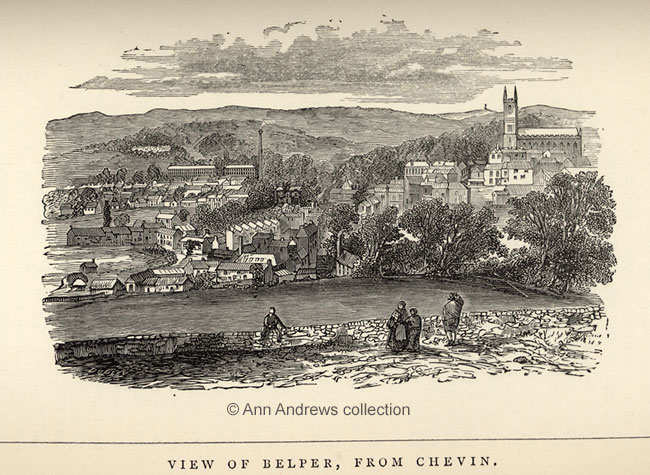 There is something singularly inspiring in this rapid rush through charming scenic surroundings. One enjoys what De Quincy calls "the glory of motion." Stay: This sudden shutting off of the steam, and the prompt application of the brake, is alarming ; but the precaution, it appears, is only taken for the safe rounding of the severe curve at Ambergate junction. Behind is our train winding round the curve like a gliding serpent, Brain of long twelve-wheeled "bogie" carriages, and a Pullman Palace Car. Before us opens out one of the most beautiful vales of the Derwent. A sylvan spot, this valley at Ambergate, with its radiant river rippling under the tinted trees ; its wonderful wealth of foliage, rising tier above tier in banks of leafy loveliness ; and its background of Derbyshire hills swelling in the sunlit perspective. Onward we urge at sensational speed, shooting bridges, whisking over the river here, booming through a tunnel there; now darting through a deep cutting, whose scarped and rugged sides diversified with feathery ferns and golden gorse; then dashing through the forest growth which skirts the park of Alderwasley, with tall trees casting soothing shadows on either side, and forming an archway of luminous leaves overhead. To our right is the tall, tower-crowned hill, Crich Cliff. Yonder, nestling among the trees on the wooded height is Lea Hurst, the Derbyshire home of Florence Nightingale. Whatstandwell, in all its wooded beauty, is left behind. Cromford, with its grey church communing with the whispering river—with Willersley Castle, the residence of the Arkwrights, on the hillside—and with its naked rocks, like my Lady Godiva, "clothed on with chastity," is reached, and now Wra-a-a-ah!—a long tunnel puts a tantalising termination to the scene, a provoking full stop to the sentence. But don't protest my friend, against the tunnel robbing us, like a Scotch mist, of a fresh gleam of Fairyland. It will give us splendid compensation in a minute. Out into the sunlight again ; a brief cutting ; and then Matlock Bath bursts with startling abruptness, an enchanting surprise in scenery. It is like the dazzling glory of the home fairies, which was wont to succeed the goblin scene in the old-fashioned pantomime of our boyhood. One is almost tempted to call, like a gallery-god, for "Scene Painter,"—after the manner of that enthusiastic tourist, who, beholding the Bay of Naples, exclaimed, "Bravo, Beverley!" Matlock Bath looks like an exquisite Swiss miniature, a Neufchatel in a nutshell. But we have not time even for a note of admiration. Another tunnel obliterates the pleasing prospect, The High Tor towers above us ; a momentary glance of rock and river ; and then the yawning darkness of yet another tunnel receives the train. Out again, and Matlock Bridge flies past with lightning-like velocity. Quick! and you will discern the aboriginal parish church, and Matlock Bank with its temples sacred to hydropathic horrors. Now comes the sacred peak of Oker Hill ; then Darley, with its tranquil old church, sheltered with a yew tree that was contemporaneous with Homer's heroes. What a maze of sidings there are at Rowsley, the threshold of Haddon Hall and Chatsworth. Here the Wye and the Derwent fall into each others arms ; there is the "Peacock," with its ivied mullioned windows, and quaint gables, and clustered chimneys and old-fashioned garden. Presently we are at the portals of the long tunnel which burrows under the time-hallowed towers of Haddon Hall. The Midland system was arrested at Rowsley for some time because his Grace the Duke of Rutland was opposed to the railway running in the valley past Haddon Hall, and so the line passes under the wooded hill-side upon which the feudal walls are reared. Perhaps it is best that it should be so. The baronial palace should be read slowly and studiously, like a book, room after room, from basement to battlements, not hurried past at the sensational pace of a mile a minute. We are in the tunnel now with a swift procession of black goods trucks passing, which "covered with palls, and gliding on like a weird funeral, convey themselves guiltily away, as if their freight had come to a secret and unlawful end." Out into the genial light of day again, with the scent of meadow-sweet, instead of the smell of damp mould. The Wye wanders in the fields in a hundred serpentine paths of its own choosing. There are views on either side—before, behind, to the right and to the left. The signal stands against us at Bakewell. The hiss of the "Westinghouse" checks the speeding train. Tinkle ! Tinkle ! sounds the electric block-bell in the pointsman's box ; down drops the horizontal arm of the tall semaphore ; the steam is put on, and soon Bakewell, with its heaven-pointing spire, tucked in among the hills of the Peak, sinks behind. It is collar-work for the Iron Horse now. Up hill, and no mistake. Past Hassop and Longstone, with far-stretching dark moors climbing to the sky-line. Chay! chay! chay! again with distinct pants. The regulator is pushed on at the full. Curves and gradient. More coal, if you please. The locomotive, like the fat boy in the Pickwick Papers, is always demanding refreshment. The coal-laden shovel is scarcely ever absent from its hungry mouth, while its consumption of water shows thirsty weakness for agua pura, which ought to induce the Good Templars to make the Iron Horse their patron saint. But do not let us malign the active animal. A steam-pressure, which runs up to 150 pounds to the square inch needs some support, you know. Monsal Dale carries us into a region of romantic enchantment. The Wye, winding under wooded bank and jutting cliff, is one of Nature’s daintiest water-colour sketches. At Cressbrook the scenery reaches a climax of poetic beauty. But tunnel after tunnel robs us its charms; and it is, moreover, tormenting to rush through this scenery and not to be able to pause and enjoy it. One is inclined to bribe the engine-driver to "pull up," and to superannuate the stoker and guards into silence. Tantalus was placed in a provoking position when he was surrounded with every variety of luscious fruits which always eluded his grasp. It was "hard lines" for Sisyphus to be or ever condemned to roll a huge stone up to the top of a mountain, and for the stone to break away from him just as it was gaining the mountain summit. It was unsatisfactory for the daughters of Danaus to be compelled to fill with water a vessel full of holes. It is maddening for a starved wretch to behold the savoury bounty of eating-house windows, and not to be able to purchase a single crumb. It is exasperating to receive a barrel of oysters, and yet have no knife wherewith to open the toothsome bivalves. But more teasing than all these is to rush through the panorama of the Peak and not be able to stop and drink in the scenic beauties it your leisure—to linger in the secluded glen where the scenery of the banks woos the glancing stream, to climb the stubborn hill and receive the guerdon with which nature regards the arduous ascent. A pause, if it please you, at Miller’s Dale, where a little crowd of passengers awaits the train. Here Mr. Salford, from Manchester, who has left his rheumatism and crutches behind at Buxton, gets nimbly in the express along with Mrs. Salford, and the two Miss Salfords, one a charming symphony in silk, the other a dainty vignette in velvet. Mr. Saltley, of Birmingham, very gouty and bound for Buxton, gets out, and there is an interchange of several other passengers. Now the guard blows the whistle to proceed again, and the engine answers with a scream. A stout gentleman, who carries a red nose and a fishing-rod, pants pathetically up the platform in a perspiration and a hurry. But he is just one puff too late, and in waiting for the next train he will have time to moralize on the evils of unpunctuality. We are now running by the side of the Wye, on a terrace on the hill-side. The tunnel robs us of many charming pictures, but the ride is remarkable for sweet surprises in scenery." The train rushing from the mouth of one limestone tunnel, crosses the river bridge thrown high up above the wild beauty of Chee Dale, only to plunge into another vault. But that transitory flash of Chee Dale is one of the most remarkable "bits" of the journey. The ravine along which we now thunder is Blackwell Mill Junction. That lonely cluster of houses is a row of isolated platelayers’ cottages ; that heap of ruined stone is Blackwell Mill; to the left is the loop line that runs round the rock side to Buxton. Now we are climbing up the steep gradient along Great Rocks Dale. Peak Forest now, whose woods were once the refuge of wolves, and whose church—a sort of Gretna Green in the Peak—was the haven of runaway lovers. Soon Dove Holes is reached, and the line drops down towards Manchester through a tunnel two miles in length. The black obscurity now envelopes us—a detonating signal explodes with a loud report under the wheels, and the iron monster gives an unnatural scream, as though it had received a death-wound, and with palpitating heart and quivering sides pulls up in the Stygian vault. A caution signal sends us on at slackened speed, then a white light waved in the darkness puts the steam on again. That scream has sent strange echoes flying. Ten thousand and one noises seem to compete in a clattering chorus of deafening, deadening din. The darkness may be felt. Sulphur fumes are added to the damp earthly smell. The circle of white light, thrown out by the furnace-fire, makes ghastly the faces of the enginemen at their post, peering through the gloom. A reverberating rumble is heard quite near. Two red ogre-eyes are burning their way through the darkness. In another second an avalanche of thunder and lightning is hurled past on the " up-line " with awful velocity. With a shriek, and a rattle, and a roar, on and still on. Fantastic flakes of fire flutter from the engine chimney, and fly fitfully overhead. Now and again an air-shaft in the tunnel-roof sends down a delusive glimmer of day. Right in front is the tunnel-mouth, in size looking like a threepenny bit : it gets larger: now it assumes the dimensions of a sixpence: it grows into a shilling : soon it appears like a florin, and presently resembles a five shilling piece. Another half-minute in this vile vault, and then we burst into the summer sunshine again. Viaducts carry us over Chapel-en-le-Frith, and give us Admondeus-like privileges with regard to peeping down cottage chimneys and into bed-room windows. Down the hill-side now as if the Iron Horse were a frightened Pegasus and were running away altogether. The steam is shut off; ever and anon the sibilant sound of the air brake is heard. That station I think was New Mills ; but the pace is so rapid that the letters on the platform name-board were running into each other. The rivulet running by the line is the Kinderbrook. To the right, Kinderscout—the king of the Peak mountains—sets his shoulders against the sky. At Marple the charm of the scenery diminishes. We have passed through the Peak. The Rubicon is crossed, and the poetry of Derbyshire gives way to Cheshire and Lancashire prose. God’s country is forsaken for man’s Own, and presently the engine, breathless and palpitating, pants into the Cottonopolis terminus. Good-day Toodles, may we meet again !  X  Edward Bradbury undertook another remarkable railway journey is described on the next page. Edward Bradbury undertook another remarkable railway journey is described on the next page. |
||||||||||
|
*Transcribed by Ann Andrews in November 2025 from her personal copy of the book. Bradbury, Edward (1884) "All about Derbyshire." With sixty illustrations by W. H. J. Boot, J. S. Gresley, W. C. Keene, L. L. Jewitt, G. Bailey, J. A. Warwick, R. Keene, and others. Simpkin Marshall, London : Richard Keene, All Saints', Derby. Images © Copyright Ann Andrews collection. Intended for personal use only. |
||||||||||
Related pages elsewhere on this website:
|