|
|
WRITER on Derbyshire scenery somewhere
says, that when Nature had completed Switzerland, there was
left one romantic fragment for which she had no further use
in that country, so she set it in England, and it was called
Matlock. The happy conceit hits off Matlock better than many
pages of diffuse description. Enthusiastic people, who have
never crossed the channel, compare Oban to the Bay of Naples,
Grasmere to Lucerne, and Torbay to Nice; the Grand Parade
at Cheltenham is to them the Unter der Linden of Berlin, and
they bestow upon the Devonshire Dart and the Monmouthshire
Wye the designation of "The English Rhine." It is no
doubt satisfactory to our insular pride to know that we compare
favourably in the matter of beautiful scenery with other countries, |
though it is somewhat invidious to seek to establish
the excellence of the scenery of one country over that of another;
but it may fairly be conceded that the comparison of the Peak district
with Switzerland is not so far-fetched as such similes generally are.
The Peak is Alpine on a
reduced scale ; it is Switzerland seen through a lessening lens ;
its hills are mountains in miniature; but it is none the less romantic,
except to people whose standard of scenery is that of mere size, and
who measure the beauty of an eminence by its bulk and height above
the level of the sea, and to whom the charm of a river lies in its
total length.

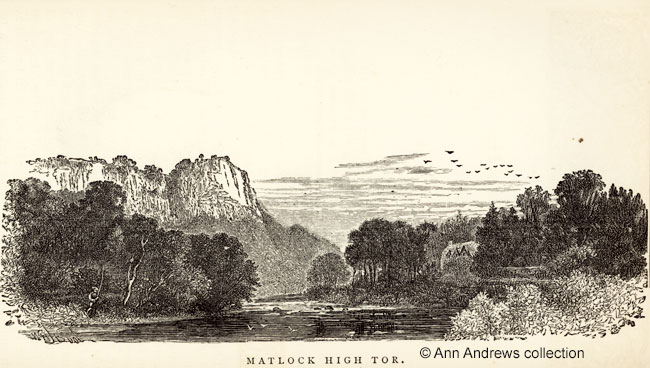
This delightful engraving of Matlock's High Tor
appears on p.298 as the frontispiece to this chapter about Matlock.
There are four Matlocks—Matlock Village or Town as it is generally
called is an old-world place of gray dwellings and ancient Parish
Church, built centuries before the other Matlocks were dreamed of;
Matlock Bath, Matlock Bank, and Matlock Bridge, all lying within
the radius of a couple of miles. To Matlock Bath belongs the most
scenic beauty; Matlock Bank is on the breast of a hill that overlooks
the rocky valley, and is monopolized by hydropathic establishments,
the largest of which is Smedley's, who introduced the "cold
water cure" into the district ; while the Bridge is the little
market town, with its railway station, down near the river.
Matlock Bath has but a modern history. Defoe, who visited the
place in the eighteenth century, writes of it:
"The Bath would be a much more frequented than it is, if a sad
stony way which leads to it, and no accommodation when you get there
did not hinder." But when good roads were made, and hotels sprung
up, the waters of the Bath were in great request. The " Old Bath
Hotel" became an establishment of repute. Gough describes the
Matlock of his day as being "much frequented by the neighbouring
gentry for health and amusement, without the infection of southern
manners." Here Lord Byron met Mary Chaworth, heiress of Annesley,
and here the episode happened, recorded by Moore, which was destined
to govern the life history of both the bard and the beauty. Byron's
letters abound in illusions to the beauties of Matlock. The original
Old Bath Hotel is not in existence. Near its site is erected a new
building of large proportions, called the Royal Hotel. In the "Visitor's'
Book" of the New Bath Hotel, Mr. Ruskin's name occurs more than
once. This comfortable caravanserai is one of the institutions in
a town or hotels, of which the Temple, Hodgkinsons, the Devonshire,
and the Old English at Matlock Bridge, will be recalled by the readers
of this page. All lovers of trees should see the
ancient lime tree in the pleasant gardens of the New Bath Hotel. This
tree has weathered more than 300 winters, and is a marvel of arboreal
growth, its wide spreading branches covering a space of more than 300
square feet. It is justly considered a wonder among trees.
In 1815, Scarthin Rock was cut through, and the present road made.
Then the era of railways came. The Midland line, which at first halted
at Ambergate—the very threshold of the Peak country—blasted
its way through rocky cuttings and trecherrous tunnels to reach Matlock
and Rowsley, where it was arrested, and, after a long pause, forced its
civilizing way to Buxton and Manchester. The railway made Matlock. It
destroyed the former social splendour of the "Old Bath Hotel,"
but it has transformed the chrysalis-grub of a lead-mining hamlet into
the gay butterfly of a fashionable watering place. The wilderness Defoe
deplored is now covered wih houses, and hotels, and shops. Every old
lead-working has become a "natural cavern," with a showy name,
to catch the loose sixpences of the excursionists who come from the mills
of Manchester and the stithies of Sheffield, and the lace looms of Nottingham,
and the workshops of Birmingham, and from the centres of industry even more
remote, to breathe the "caller" air of this "English Switzerland",
much to the genteel disgust of the elegant residents of the place. But even
excursionists cannot vulgarize Matlock, for her limestone crags are everlasting
in their grandeur, and the trees which clothe their sides with garments
of green renew their beauty every year.
The Lovers' Walks wind under those cliffs among those trees, with the Derwent
making graceful curves by their side. A ferry across the river gives access to
this charming locality in which wood, water, and rock are blended with pleasant
scenic effect. The Walk leads under a Gothic archway of embracing elms, whose
leaves shed a trembling tracery of light and shade on the path. Matlock spreads
itself out like a picture on the other side of the river. The Lovers' Walks deserve
their amorous title. They are just the plce for Strephon and Chloe to pursue their
reveries, and exchange their sweet confidences and whispered confessions. The
musical river whispers wooingly to the hanging greenery of the banks, and the plash
of oars is heard in the stream,
as a light skiff shoots past, with a fair Undine giving a dash of
picturesque colour at the helm. It is pleasant to sit in the sylvan
shade in the springtime, when the trees behind are jubilant with
feathered builders, and the jackdaws are calling to each other in
the ivy of the crags, and the leafage is of that luminous, tender,
delicate green which the scorching sun soon dims into a dingier hue.
Pleasanter still, perhaps, is this retreat in the autumn time, with "the deep colour
of the woods and the silence of the birds," when the beech leaves
are burnished like bronze, and the sycamore covered with tints of
red, and the birch splashed with yellow, and ever and anon a dying
leaf falls with an audible sigh of regret at your feet.
Side paths diverge from the main paths of the Lovers Walks, and
climb up the Hag Tors, magnificent pieces of rock scenery, whose
gray limestone turrets are trellised with clinging trees, and wild
flowers, and glossy ivy, and whose rocky recesses are luxuriant
with vegetation. Here and there a retiring bower, at some "coign
of 'vantage," offers a rest and a panoramic prospect, embracing
all that is beautiful between Masson and Harp Edge, and the view
is one of the finest that you can obtain in Matlock. Far away below,
the Derwent glances among the trees, as it glides on to the weir,
beyond which it lends beauty to the green slopes crowned by Willersley
Castle, the mansion of the Arkwrights, first becoming useful at
Cromford, "the cradle of the cotton manufacture," where are
the mills founded by Sir Richard Arkwright, the Preston barber's apprentice.
Next to the Lovers' Walks, the Heights of Abraham attract lover
of the picturesque. "Why Heights of Abraham?" is the
natural query of the visitor to Matlock who climbs up the wooded
hill which is really a lower slope of Masson. He may perhaps fancy
that the name has some occult collection with the petrifying spring
in the street below, which, going into the primitive ages for
a patron, is advertised as "Jacob's Well." These heights,
however, owe their name to a supposed resemblance they bear to
the Heights of Abraham at Quebec. The whole hill-side is a woodland
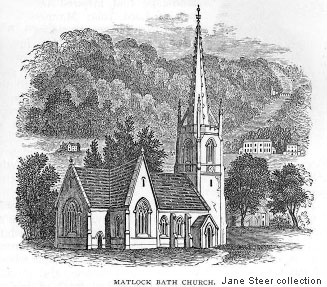
mass of varied shape and diversified hue. A church, Swiss-like
cottages, and castellated buildings, break the monotony of the
billowy mass of green. A prospect
tower too much like a chimney for picturesque effect, crowns the
summit. Much has been done, by winding walks, and the provision of
rustic seats at frequent intervals to modify the difficulty of the
ascent; and one is rather surprised when he is informed that the
mountain, after the expenditure of the energy required to reach the
summit, is only a trifle over a thousand feet high. The
exertion, however, is rewarded by the panorama, which is a feast to the eye
accustomed even to the grandeur of the views
from more lofty altitudes. The Prospect tower hangs over an Avernus-like
descent of woodland scenery. Away below is the curve of the Matlock
valley, a deep ravine, on one side of which rises the mountain slopes
of Masson, and on the other, tall, fantastic crags, draped with green,
stretching from Scarthin Nick, past Hag Tors, to the impending precipice
of High Tor, which seems less startling and stupendous when viewed
from this standpoint, as the Riber hill-side, crowned with the towers
of Riber Castle, rises to a greater height immediately behind it.
The Chapter continues on the next page
|